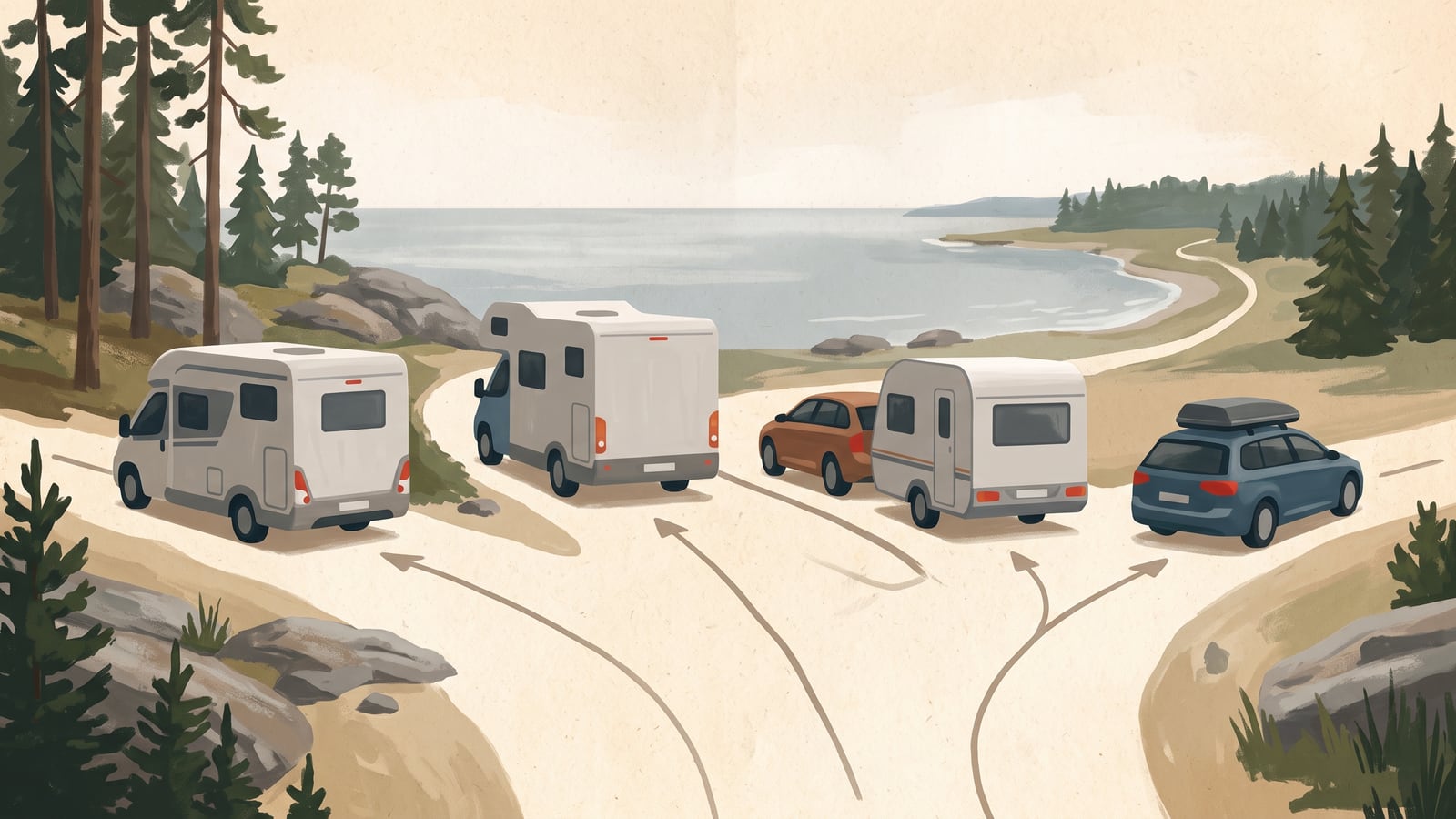
The real question isn't which setup is best. It's whether your bed and your engine should be bolted together.
That choice shapes most of an ordinary touring day — parking, settling in, narrow lanes, and how much you pack away before you can go buy milk. Get it right for how you want to travel, and the rest of the decision mostly follows.
This compares four ways to travel — campervan, motorhome, car-and-caravan, and car with a hotel, cabin or tent — across driving, parking, camp setup and errands, then narrows things to a shortlist. A checklist near the end covers the legal, insurance and roadworthiness detail to verify before you sign or pay.
The everyday touring day
Picture the same afternoon played out four ways. In a campervan, you find a space, pull in, and you're more or less home — what drove you is what you sleep in. A motorhome works the same way but is bigger, so finding that space takes more thought. In a caravan, you unhitch the trailer, level it, and now have a free car sitting beside it. In a car with a hotel or tent booked, you park, unload your bags, and the vehicle's job for the day is done.
The next morning, when you just want bread and a look around, only the caravan and car travellers have an errand-ready car; the others drive the whole rig in or leave it parked.
That's the fundamental divide: does your living space travel attached to your engine, or does it stay put while a separate car handles the day's errands? Parking difficulty, storage volume, towing skill and nightly cost all sit downstream of that one decision.
The four touring setups
Each format below is a plain-language description, not a formal vehicle category, and each has situations where it clearly fits and others where it doesn't.
Campervans and motorhomes
A campervan is a compact, self-contained living space built into a standard van footprint. It can be easier to manoeuvre and park than larger formats, which may suit solo travellers or couples who want to move often. Whether it actually fits a particular mountain road or narrow street depends on the specific vehicle's dimensions and current local restrictions, not the format alone. The trade-off is space: you'll typically convert seating to bedding each night, and storage for bulky gear is limited. Because the van is both transport and accommodation, any drive — even a short errand — usually means packing down whatever you'd set up inside.
A motorhome makes a different trade-off between living space and everyday drivability: most offer permanent beds, a full washroom and more storage, suiting families, longer trips, or anyone who wants to stand up straight rather than reconfigure furniture nightly. That comfort comes with size: height, width and length can restrict which streets, car parks and ferries are realistic, and larger motorhomes can approach or exceed the mass a standard driving licence covers — a detail the checklist below walks through before you commit to one. A motorhome fits poorly if your itinerary is built around tight historic centres or narrow rural passes, or if the driver isn't comfortable behind a large, commercial-sized footprint.
Caravans and passenger cars
A caravan pairs a towable living unit with an everyday car. Tow to a pitch, unhitch, and for the rest of your stay you have full use of an ordinary car for day trips, which may make some parking easier than manoeuvring the full touring vehicle — depending on the car's actual size and local restrictions. The cost is on the road: towing demands extra skill, confident reversing and a proper hitching routine, and the combined weight of car and trailer can call for a different licence category depending on the masses involved. A caravan makes far less sense if you're moving to a new stop every night — unhitching and re-levelling daily erodes exactly the convenience it's meant to offer.
At the other end sits the car paired with hotels, cabins or tents. There's no onboard water system, no waste tank, nothing to winterise, and route and parking access generally depend only on ordinary car restrictions rather than an additional body or trailer. What you give up is spontaneity at the accommodation end: you're booking ahead or searching as you go, and packing and unpacking at every stop — weaker for rural spontaneity without pre-booked rooms, and for tight budgets over many weeks where nightly accommodation adds up.
Narrowing your shortlist
Four questions do most of the work, without needing a scoring system:
- Mobility versus living volume. Move often and want an easy-to-park vehicle, or want space to stretch out once you've arrived?
- Travel pace. Roaming to a different stop most nights, or base-camping at a hub with day trips from there?
- Errand flexibility. Would driving your whole living space to buy groceries bother you, or would you rather have a separate car ready?
- Comfort, weather and access needs. Do you need indoor space in poor weather, easier transfers for reduced mobility, or room for bulkier luggage — and are you renting for one trip or taking on ongoing ownership?
Match your answers against the fit notes above: high-mobility roaming points to a campervan, base-camping with day trips to a caravan, indoor comfort on longer family trips to a motorhome, and no-onboard-systems travel to a car and booked stays. If accessibility needs are part of the decision, compare the exact vehicle's transfer and layout against the specific rooms, surfaces and facilities a lodging option offers — neither format is inherently more accessible without that check.
Take a hypothetical couple planning a two-week tour across alpine passes and coastal villages, changing location every night or two. Their priority is a quick evening setup — they don't want an hour of unhitching for a single night's stay. That makes a campervan the better fit here, not a caravan — daily unhitching works against their pace. Their next move: run a specific van through the checklist below.
A different hypothetical household — a family of four spending three weeks at one lake district — points the other way: towing a caravan to a pitch on day one, then using their car for the rest of the stay, keeps that car free for cramped town centres and trailhead parking all week.
What it'll cost you
Cost comparisons here stay general on purpose — your own numbers depend on where you live, what you already own, and how you book. Buying any of these means taking on fixed costs whether you travel or not: depreciation, insurance, routine servicing and somewhere to store it when it's idle. Renting turns that into a per-trip price and hands storage and servicing to someone else, at the cost of never quite having your own layout, and paying every time you go.
On top of that choice sit trip-running costs, which vary by format rather than by who owns the vehicle: fuel or energy, tolls, ferries and campsite fees — or accommodation bills instead of pitches for the car option. Which adds up to more depends on trip length, how often you'd otherwise pay for lodging, and what storage and servicing already cost you at home. Treat it as variables to check against your own situation, not a fixed ranking of formats.
Checking the vehicle before you commit
Before you rely on any of this, confirm the mass, trailer combination and licence category against the actual registration documents of the vehicle or combination you're considering, and against your national licensing authority. A shortlist from the sections above is a starting point, not a substitute for that check.
Shared checks, whichever format you choose:
- Check the maximum authorised mass of the vehicle or combination against your licence. A standard Category B licence in the EU generally covers vehicles up to 3,500 kg maximum authorised mass with up to eight passenger seats besides the driver, towing a trailer up to 750 kg. Above that trailer weight, a Category B combination may still be possible, but some Member States require extra training or a nationally recorded code once the combination exceeds 3,500 kg, and a full Category BE entitlement covers heavier trailer combinations. A vehicle over 3,500 kg maximum authorised mass falls outside standard Category B and may instead need a Category C1 or other entitlement. Confirm the exact figures for your vehicle or combination with your licensing authority before assuming a standard licence covers what you're driving.
- Licence recognition across borders. Standard driving licences issued by EU Member States are mutually recognised across the EU. Provisional licences, temporary replacement documents, and licences issued outside the EU aren't automatically valid — check recognition for each destination with the relevant licensing authority or embassy before you travel.
- Route suitability. Check the current road authority, ferry operator and parking provider restrictions against the exact loaded height, width, length and mass of your vehicle or combination — not a rough estimate. If a restriction can't be confirmed, reroute or defer that leg rather than assuming access.
- Trailer insurance. If you're towing across a border within the EU, ask your insurer whether the policy covers the whole combination, and whether the destination Member State requires separate trailer insurance — this varies by country and isn't automatic.
If you're renting: Read the rental agreement itself and notify your rental provider before crossing a border, since territorial limits, included insurance, deposit, excess, condition-report expectations and cancellation terms all depend on that specific contract rather than any general assumption about what car hire includes. Also confirm the equipment actually supplied and the assigned vehicle's layout with the provider once it's allocated — a rental category doesn't guarantee a particular specification.
If you're buying: Verify the official registration certificate and ownership transfer paperwork, the vehicle's roadworthiness or periodic inspection history, and the insurance cover you'll need as an owner directly with the relevant national authority, the seller and your insurer, since none of it can be assumed to carry over automatically from a previous owner or a different country. Alongside that, check what warranty remains, where you'll store and service it through the year, and whether your resale expectations are realistic for that make and age.
Where to go next
This comparison sits in the getting-started part of the road-touring hub. If you're still weighing whether to rent or buy the format you've landed on, how rental and ownership commitments compare over a first long tour works through that in more depth. Once you know roughly what you're spending on, how fixed ownership costs and per-trip costs behave over a season breaks that split down. Before you sign anything, which insurance and breakdown questions to ask a provider or insurer lists the specifics. All three sit within the wider road-touring section.
Your next step: pull out your driving licence and note its category codes. Later, before you book or buy, those codes get compared against the specific vehicle or combination's registration documents and the match confirmed with your licensing authority — the codes alone don't establish what you're entitled to drive.