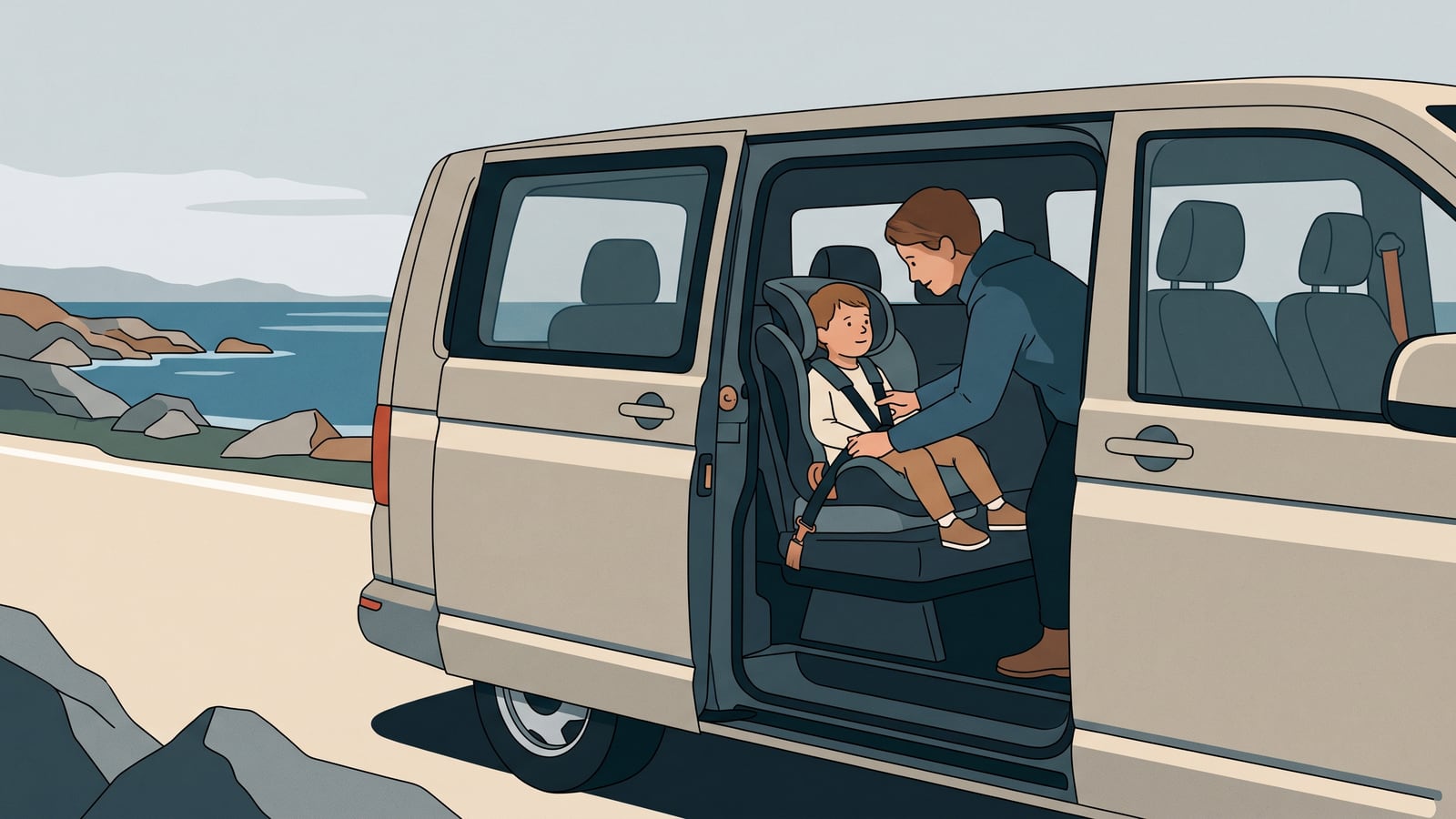
If you're driving into Sweden or Norway with children — in a car, campervan, or motorhome — the honest answer to "is this seat legal here?" depends on three different documents. Each country writes its own rule, and each rule only covers the vehicles and seating it describes. Think of this as a planning reference: something to work through at your desk before you drive, so you know exactly which facts you still need to collect.
It won't tell you how to fit a restraint, how to deactivate an airbag, whether you qualify for an exemption, which product to buy, or whether your specific setup is legal. Those questions belong to the restraint's own instructions, your vehicle's manual, the relevant authority, or — if you're renting — the provider. What this article gives you is the shape of the check, and a place to record what you find.
Three answers, one check
Think of this as three separate questions stacked on top of each other. The first is what the country requires: an age or height threshold, a rule about belted seating, who's responsible for a young passenger. The second is what the restraint itself allows: its approval marking, the weight or height range it's built for, and what its own instructions say about fitting it. The third is what your actual vehicle — or your rental agreement — permits: which seats are registered for passengers, what belt is there, and whether an airbag changes the answer for that spot.
Each layer answers a different question. The national rule tells you when a device is required. The restraint's documentation tells you its range and how to fit it. The vehicle's paperwork tells you what that seat offers. Work through the three subsections below, then use the checklist to record what you find for your own child and seat.
Check the current national rules shortly before you travel. Then repeat the check whenever any of these change:
- the child
- the restraint
- the intended seat
- the vehicle
- the provider
- the country
A check made for one trip doesn't carry over to the next.
National evidence
The country you're driving in sets the legal floor: who needs to be secured, at what age or height a special device becomes necessary, and who's responsible for a child passenger. This layer answers "is a device required here?"
Restraint evidence
A restraint's own documentation is what tells you whether it suits this child: its exact identifier, the approval marking on it, the weight or height range it states, and its own fitting instructions. A seat that worked for an older, taller child, or in a different car, isn't automatically right for this child in this vehicle. If you don't have that documentation to hand, this layer isn't complete.
Vehicle and rental evidence
The vehicle answers a different question again: which seats are meant for passengers, how many the vehicle is registered to carry, what belt each seat has, and whether an airbag at that position changes what can be fitted there. The source for this is the vehicle's manual and its seat labels, not a general impression of the interior. If you're renting, the provider's terms and the assigned vehicle's exact documentation sit in this same layer — a rental category doesn't tell you which seats you'll get.
Your per-child check
Every entry in this checklist needs a proper passenger place behind it, along with the vehicle's registered vehicle class and passenger capacity — a bed, a table seat, or the general shape of the vehicle tells you none of that, whatever the layout looks like. Run one entry per child and per intended seat: two children on the same trip can have different measurements, different restraints, and different seats, even in the same vehicle.
General national rules and recognised safety guidance do not establish compatibility for a particular restraint and vehicle; where that's still unresolved, the next step belongs to the relevant authority, the restraint or vehicle manufacturer, the rental provider, or qualified assistance — whichever one holds the missing piece. The checklist below exists to help you find out which piece is missing, not to close the question on its own.
What the statuses mean
Each entry ends in one of three statuses, and they're not interchangeable. Verified for this trip means the entry has been checked against the current official source for this specific child, this restraint, this vehicle, and this travel date — and the entry names that source and the date it was checked. A confirmation from an earlier trip, a different child, or a different vehicle doesn't count. Clarification needed means a specific question is now out to a named holder — the relevant authority, the restraint or vehicle manufacturer, or the rental provider — and you're waiting on their answer. Pause means the travel arrangements that depend on that answer wait until it comes back: don't confirm a non-refundable booking, load the child into that seat, or set off while any entry sits at clarification needed for something the trip actually depends on.
Blank entry
Copy this for each child and each intended seat:
- Country or countries of travel: ______
- Child's age: ______
- Child's current standing height: ______
- Child's weight (where the restraint's range depends on it): ______
- Exact restraint model or identifier: ______
- Approval marking on the restraint: ______
- Applicable child range stated by the restraint: ______
- Restraint instructions consulted (yes/no, and when): ______
- Vehicle make and model, or rental booking reference: ______
- Registered vehicle class and passenger capacity: ______
- Intended passenger-place position (for example, rear, offside): ______
- Belt configuration at that seat: ______
- Airbag status at that seat: ______
- Vehicle manual or seat-label reference checked: ______
- Rental-provider terms applicable, if any: ______
- Applicable travel date for this entry: ______
- Sweden source consulted (title or link) and date checked: ______
- Norway source consulted (title or link) and date checked: ______
- Sweden result: ______
- Norway result: ______
- Restraint documentation result: ______
- Vehicle documentation result: ______
- Rental confirmation result: ______
- Final status: verified for this planning question / clarification needed / pause
If any field above lands at clarification needed, log the specific unresolved fact separately — one line per open question:
- Unresolved fact: ______
- Who holds it (authority, manufacturer, rental provider, or other): ______
- Follow-up requested (what you asked, and when): ______
- Revisit trigger (what makes you check this again): ______
Hypothetical pause example
Here's what an honest, incomplete entry looks like. Say you're planning a trip that takes one child through Sweden and then Norway, sitting in the rear of the vehicle.
- Country or countries of travel: Sweden, then Norway
- Child's age: 4
- Child's current standing height: 101 cm
- Child's weight: 16 kg
- Exact restraint model or identifier: not yet copied
- Approval marking on the restraint: not yet copied
- Applicable child range stated by the restraint: not yet copied
- Restraint instructions consulted: not yet copied
- Vehicle make and model, or rental booking reference: unknown — booking reference not yet received
- Registered vehicle class and passenger capacity: unknown
- Intended passenger-place position: rear, offside seat
- Belt configuration at that seat: clarification needed
- Airbag status at that seat: clarification needed
- Vehicle manual or seat-label reference checked: clarification needed
- Rental-provider terms applicable: clarification needed
- Sweden result: clarification needed — 101 cm sits below Sweden's child-device threshold, but that only applies if the assigned vehicle falls within the vehicle scope the Swedish rule covers, and the vehicle's registered class along with the restraint's exact identifier and marking remain unknown
- Norway result: clarification needed — Statens vegvesen's under-135-cm requirement applies to children travelling in a car, and the vehicle's registered class and the restraint's documentation remain unknown
- Restraint documentation result: clarification needed
- Vehicle documentation result: clarification needed
- Rental confirmation result: clarification needed
- Final status: pause
The child's age, height, and weight are ordinary trip facts — they don't hold anything up. What stops this entry short is that the restraint's identifier, its approval marking, the vehicle's registered class, and the seat's belt and airbag details are all still unknown, and none of that can be guessed from the trip plan. The next move is straightforward: get the restraint's model and marking off the product itself, get the vehicle's registration details and manual from the owner or rental provider, and confirm the seat's belt and airbag status before treating this arrangement as workable.
Hypothetical rental example
The pause example above still had a private vehicle's registration details behind it, even if they hadn't arrived yet. A rental adds an earlier gap: sometimes you don't know which vehicle you're getting until close to collection, and you may not know whether the provider supplies a restraint at all. Say a different family is planning a similar Sweden-then-Norway trip in a rented motorhome, and starts this checklist before the provider has assigned a vehicle.
- Country or countries of travel: Sweden, then Norway
- Child's age: 6
- Child's current standing height: 118 cm
- Child's weight: 20 kg
- Exact restraint model or identifier: not yet known — waiting to hear whether the provider supplies one or the family should bring their own
- Approval marking on the restraint: not yet known, same reason
- Applicable child range stated by the restraint: not yet known
- Restraint instructions consulted: not yet known
- Vehicle make and model, or rental booking reference: booking reference BR-2026-0417 (invented); vehicle not yet assigned
- Registered vehicle class and passenger capacity: unknown until assignment
- Intended passenger-place position: rear, nearside seat — requested, not yet confirmed
- Belt configuration at that seat: unknown until assignment
- Airbag status at that seat: unknown until assignment
- Vehicle manual or seat-label reference checked: not applicable yet
- Rental-provider terms applicable: clarification needed — question out to the provider about restraint provision
- Applicable travel date for this entry: the date of the Sweden-to-Norway crossing on this booking
- Sweden source consulted (title or link) and date checked: not yet checked against this vehicle
- Norway source consulted (title or link) and date checked: not yet checked against this vehicle
- Sweden result: clarification needed — 118 cm sits below Sweden's child-device threshold, but the vehicle's registered class and the restraint's identifier and marking are still unknown
- Norway result: clarification needed — Statens vegvesen's under-135-cm requirement applies to children travelling in a car, and the same details remain unknown
- Restraint documentation result: clarification needed
- Vehicle documentation result: clarification needed
- Rental confirmation result: clarification needed
- Final status: pause — no non-refundable onward leg gets booked until the vehicle and restraint are confirmed
Unresolved item logged against this entry:
- Unresolved fact: whether the provider supplies a compliant restraint for this child or expects the family to bring their own
- Who holds it: the rental provider
- Follow-up requested: message sent asking the provider to confirm at vehicle assignment (below)
- Revisit trigger: vehicle assignment confirmation, or seven days before collection, whichever comes first
Once a vehicle is assigned, that's the moment to put the open questions to the provider directly, rather than guessing from the vehicle category on the booking. If a payment or cancellation deadline lands before the assignment, don't wait for it: contact the provider immediately and ask which of these facts — seat layout, restraint provision, permission to bring your own — it can guarantee in writing by that deadline, whatever vehicle is eventually assigned. Whatever can't be guaranteed by then stays an unresolved fact, and the pause rule applies to it: a non-refundable commitment that depends on an unguaranteed answer waits. Here's the kind of message that does it — every detail in it is invented for this example:
Hi [provider] — you've now assigned us [vehicle make and model] for booking BR-2026-0417. Before we collect it, could you confirm: the vehicle's registered passenger capacity and seat layout; whether a compliant child restraint is fitted or supplied for a 6-year-old, 118 cm, 20 kg child, or whether we should bring our own; the belt type and current airbag status at the rear nearside seat; and whether your rental terms permit a family-supplied restraint if none is provided. We're travelling through Sweden and then Norway and need this confirmed before departure. (invented text, example only)
Travelling with more than one child, or with mixed arrangements — the provider supplying a restraint for one child while the family brings its own for another? Ask the questions per child in the same message, naming each child's height and weight separately, and add the approval clause for each family-supplied restraint alongside each provider-supplied one. One combined answer that doesn't say which child it covers isn't a confirmed answer for either.
Say the provider replies confirming a make and model, the registered seat count, and that no restraint is supplied for a child this age — the family will need to bring their own. That reply fills in the vehicle make and model, registered class, and rental-provider-terms fields above. It still leaves the belt and airbag status at the actual assigned seat, and the brought restraint's own documentation, to check against Transportstyrelsen's and Statens vegvesen's current pages before the entry can move past clarification needed.
Sweden
Sweden and Norway must be checked separately, and everything below applies only within the vehicle scope stated by the source it comes from. Don't carry a Swedish answer into Norwegian planning, or the other way round. One scope gap matters for this site's readers in particular: neither cited source states in terms where a registered motor caravan, campervan, or motorhome falls among its listed vehicle categories. That classification comes from the vehicle's own registration class — check what the registration document says, put that class to the national source (or the rental provider, for their vehicle), and until it's confirmed, treat the restraint requirements as applying rather than assuming your vehicle sits outside them.
Places, thresholds and responsibility
Sweden's rules cover passenger cars, lorries, converted-car tractors, and certain three- or four-wheeled motorcycles or mopeds with bodywork. In those vehicles, occupants must sit in a belted place and use the belt when one's available. A child shorter than 135 cm needs a child car seat, booster cushion, or other special child-protection device — used instead of the belt or together with it. The driver is specifically responsible for making sure belts or child devices are used by passengers under 15.
Sweden's regulation also requires a car passenger to sit in a place intended for passengers, within the vehicle's registered capacity — not any seat that happens to be free.
Limited exceptions
Sweden allows two limited exceptions, and each applies only under these exact age, journey, device-availability, and seat conditions — neither is meant as ordinary touring advice.
The first covers a child aged at least three but shorter than 135 cm, on a temporary short journey, and only when no special child device can be used at all. The belt must still be worn where possible, and the child can't sit in the front seat of a passenger car or light lorry.
The second is separate and narrower: a child under three, on a temporary short-distance taxi journey, again only when a special device can't be used, and again excluding the front seat.
Outside those exact conditions, the standard threshold from the previous section applies.
Device conditions
The Swedish rules require the restraint to meet a listed approval basis or a later version, suit the child using it, be fitted according to its own instructions, and be used as intended — check the exact marking and applicable range on the item itself rather than trying to work out the underlying technical standards from general reading.
Airbags in Sweden
A rear-facing child restraint must not be used in a seat with a frontal airbag unless that airbag has been deactivated, and the exact vehicle manual is what you consult to confirm a seat's current airbag status — this article gives no procedure for deactivating one. If you can't confirm the airbag's state at a rear-facing seat, leave that entry at pause rather than guessing.
Norway
What follows is current authority guidance: Statens vegvesen states these summaries on its public pages, rather than text drawn from the underlying regulation itself, so treat it as a summary to verify against the source, not an inspected legal quotation.
Thresholds and responsibility
Statens vegvesen says children travelling in a car must be secured, and the driver is responsible for passengers under 15. Children under 135 cm need approved equipment suited to their weight and height. Children from 135 cm to 150 cm must use approved equipment when it is available in the car.
Markings and cars without belts
The current authority page lists ECE R 44.03, R 44.04, and R129 as the relevant marking classes, and says the marking identifies the applicable weight or height class — check the exact marking and applicable range on your item rather than expecting one formulation to explain another.
The same guidance covers vehicles without belts too: a child under three can't travel in a beltless car at all, and a child over three can't use the front seat of one. Two separate rules, for two different ages.
Airbags in Norway
Norway keeps two statements distinct here, and it's worth keeping them that way rather than folding one into the other. Statens vegvesen says a rear-facing child seat must not go in a front passenger seat with an active airbag, and separately advises that a child shorter than 140 cm should not sit in a front seat where the airbag hasn't been switched off — the first is a firm prohibition for a rear-facing seat, the second is advice to check, and the exact vehicle manual is what you consult to confirm either.
When to pause
If any of these is missing, the entry stays at clarification needed or pause:
- the national result for the country you're in
- a confirmed proper passenger place
- the vehicle's registered class and capacity
- the restraint's exact range and instructions
- the belt and airbag condition at that seat
- the vehicle's own documentation
- for a rental, the provider's permission and terms
If you're renting and the vehicle hasn't been assigned yet, the hypothetical rental example earlier in this article shows what to put to the provider once it is.
None of the sources checked in this article establish that a specific restraint fits and works safely with a specific vehicle; where that's still unclear, the next move belongs to the relevant authority, the restraint or vehicle manufacturer, the rental provider, or qualified vehicle or child-restraint assistance — whichever one actually holds the missing detail. A completed checklist that still has blanks in it is telling you exactly that — those gaps are the reason the entry can't move past pause.
Where to go next
This article sits in the life on the road hub, alongside the wider planning work that shapes a family's day on tour rather than just a single restraint check. If you're building the rest of a manageable day, how to plan a comfortable day on the road covers pace and stops; before you set off, the six-part departure check covers the vehicle beyond seating; and if you're also loading gear around the children's seats, how to pack and secure loads for road touring is the companion piece. All three sit within the broader road touring section if you want to plan further ahead.
Your next step: create one checklist entry for each child and write in the countries that child will travel through.