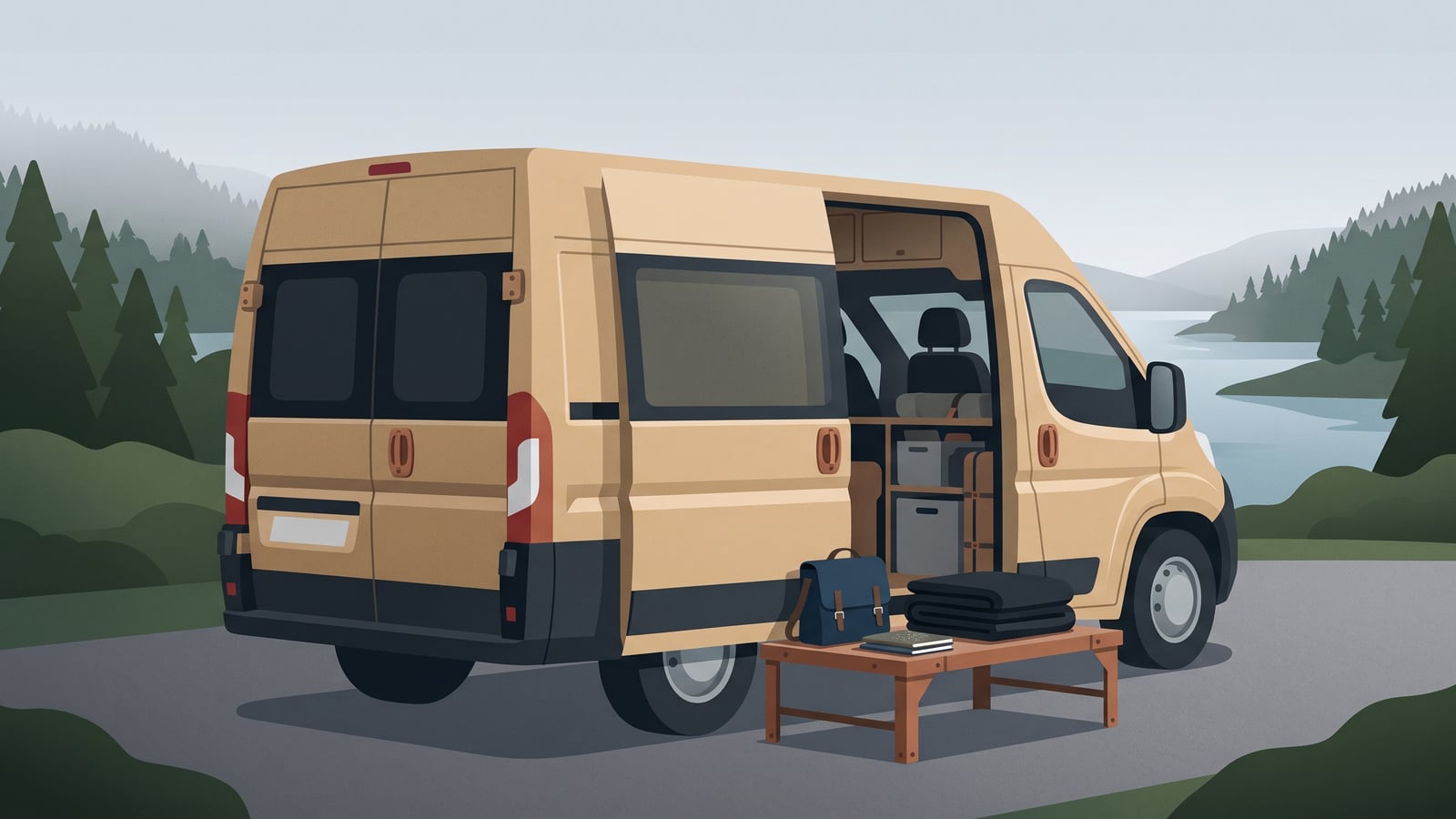
An item that fits neatly in a cupboard isn't the same as an item that's secured for travel. A cupboard can hold something in place while the vehicle's parked, then lose that grip the moment you brake hard or swerve round something in the road. So before you drive, work through your belongings in order. Start with what could move, then check what your vehicle's documents allow, choose the right storage, handle anything left over, and confirm you can still see and steer properly.
This article gives you that sequence, plus a checklist to run before you pull away. Think of the checklist as a visible check, not an engineering assessment: it can catch something obviously loose, a door that won't stay shut, or a mass limit nobody's confirmed. It can't tell you whether a locker, hook, or strap is rated for the job, and it doesn't certify that your load is legal or built to survive a collision. Fitting, rating, installing, or repairing restraint hardware isn't something this article covers — that's a job for the rental provider, the converter, or a qualified vehicle service, not an improvised fix.
Start with what can move
Before you decide where anything goes, walk through what you're carrying and ask what each item could do under sharp braking or in a collision. Unsecured objects can be thrown forward in a collision or sudden stop and may cause serious damage, so ask this question before you worry about how tidy anything looks.
Group items by what they could do:
- Heavy or dense items — cookware, tools, water containers, batteries. Give these priority when you're choosing storage.
- Items that can roll, tip, open, or break — bottles, boxes with lids, anything on a shelf without a lip.
- Small loose objects that could reach the driving or passenger area — phones, cups, loose stationery, anything currently sitting on a dashboard, seat, or open surface.
- Items whose storage or restraint you're not sure about — anything you've put somewhere because it fit, not because you checked it belongs there.
That last category is the one worth pausing on. Don't just grab a strap, net, locker, or hook because it looks the right size. Documentation for that exact use is what turns a storage spot from a guess into a checked answer, and that's the next step.
Read the vehicle first
Before choosing where anything goes, find out what your vehicle allows. That means the base-vehicle handbook, any converter documentation for a campervan or motorhome conversion, fitted labels near compartments or hooks, the registration document, and the rental-provider instructions where applicable. Different documents cover different ground: the handbook may set overall mass limits, converter documentation may describe locker capacities, and a rental agreement may add its own storage or access rules. Treat this as a set of sources to check together.
Don't guess these limits from the words "campervan" or "motorhome," from how the vehicle looks, from an advertised empty mass, or from a similar model you've travelled in before — two vehicles that look alike can carry very different documented limits.
This article doesn't walk you through calculating payload or axle loads — that's a separate, more technical job. But it will say this plainly: if you can't confirm an applicable mass limit for your vehicle, that's a reason not to depart, not a detail to skip. Swedish law is specific on this point: in Sweden, under the inspected Swedish rules, a vehicle's total weight must not be exceeded while driving. Treat an unconfirmed limit the same way wherever you're travelling, even where the exact statutory wording hasn't been checked for this article.
Place and contain the load
Once you know what your vehicle permits, you can start placing things. The starting principle is straightforward: put heavier portable items low and reasonably close to the vehicle's centre, then check that the location and its closure are meant for that item.
This isn't a motorhome-specific rule pulled from vehicle engineering. It's car guidance — Swedish and Norwegian road authorities advise low and central placement for cars — and using it in a campervan or motorhome is a conservative transfer, not a certified method. Treat it as a reasonable starting assumption, then check the exact vehicle documentation before you rely on any particular locker, shelf, or strap point to hold it.
Choose documented storage
The transferable part of the car guidance is simple: support items so they can't fall, contain them so they can't roll, and lay flat anything that might tip over on its own. Swedish guidance for passenger cars also suggests placing loads against seatbacks and sides, keeping heavy items off the parcel shelf, and using load eyes where they're fitted. Those specific examples — seatbacks, parcel shelves, rear seats, glove compartments, luggage compartments — are car layout features. A campervan or motorhome has a different interior, so borrow the underlying idea — support, containment, no toppling — rather than hunting for a parcel shelf that doesn't exist in your vehicle.
A hook or load eye that's visibly fitted in your vehicle doesn't tell you its rating or intended use on its own. The only way to know is to check the documentation for that fitting, or ask the converter or rental provider directly.
Check visible movement
Once something is stored, do a short hand check: push or gently shake the item and see whether it moves, whether the door or lid stays shut, and whether anything shifts audibly. This is a useful screening step, not a force test, a collision test, or a rating check — it can't tell you how the closure or restraint will perform under real braking or collision forces. If something moves, tips, or the closure won't hold, that's your answer: find documented storage that works, or accept that the item needs to travel differently.
Keep the driving space usable
Once you've settled where things go, check the effect from the driver's seat. In Sweden, under the inspected Swedish rules, a load can't obstruct the driver's view or ability to manoeuvre, or obscure the direction indicators, stop signals, lamps, or headlamps. Norwegian guidance for cars makes the same point about keeping the driver's view clear. The Swedish statement is law for Sweden; the Norwegian statement is car guidance, not a governing rule for a campervan or motorhome. Outside those scopes, treat a clear driver's view and unobstructed manoeuvring as a general visible check, and confirm current law and your vehicle documents before relying on it.
People often look for one universal rule about keeping exits and safety equipment clear in every campervan and motorhome. No source inspected for this article supports a rule that broad, so this article doesn't state one. What it can tell you is narrower and more useful: follow the access requirements in the exact vehicle and rental documents for your vehicle. A converter or rental provider may specify which exits, fire extinguishers, or emergency equipment need to stay reachable — that specification is what governs your vehicle, not a generic assumption.
Final-load checklist
This is a visible check you can run just before you leave. It can find obvious problems — something loose, a door that won't stay shut, a limit nobody's confirmed. It does not certify that your load is safe, legal, properly restrained, or ready for a collision — if anything on this list stays uncertain, do not drive if uncertain, and resolve it first.
- All loose portable items are in documented storage or contained by a documented method for this vehicle.
- Nothing visibly moves, rolls, tips, or can reach the driver or passenger area.
- Heavier items sit low and reasonably central, in a spot the exact vehicle documentation permits.
- The driver's view, controls, and ability to manoeuvre are unobstructed.
- You've confirmed applicable vehicle mass limits from documentation — this checklist doesn't calculate them for you.
- Every compartment, closure, attachment point, and restraint you're relying on is documented for that use, shows no visible damage or unresolved uncertainty, and shows no unintended movement during the visible check.
- You've met the access requirements in the exact vehicle and rental documents for your vehicle.
- You won't leave if a load is insecure, a closure won't stay shut, hardware capability is uncertain, or an applicable limit can't be confirmed.
- If a load shifts, a compartment pops open, you hear something unusual, or what you're carrying changes, you'll stop safely and repeat the checks above.
If a closure, compartment, or attachment point stays uncertain after checking the documentation, that's a question for the rental provider, the converter, or a qualified vehicle service — not something to solve with an improvised fix or a tighter knot.
Check the country rules
The packing method above is reusable, but the law behind it is not the same everywhere. In Sweden, under the inspected Swedish rules, loads must not obstruct the driver's view or manoeuvring, must not create the specific harms set out in traffic regulation, must be secured where the nature of the load or the load space makes that necessary, and must not push the vehicle over its total permitted weight. Those rules are stated for Sweden specifically, so don't assume they carry over unchanged to a neighbouring country.
The Norwegian material this article draws on is road-authority guidance for cars — useful for the underlying packing principles, but not verified statutory wording, and not confirmed to extend to campervans or motorhomes in the same terms. This article doesn't state Finnish loading law or Norway's detailed legal requirements — the current governing texts weren't inspected for this piece. Before you rely on any of this for a specific country, check both the current national road or transport authority and the governing legislation for that country — guidance pages are a helpful starting point, but they aren't the law itself.
Before you drive
Open the base-vehicle handbook, the converter documentation, the fitted labels near compartments and hooks, the registration document, and the rental-provider instructions where applicable. Note whatever storage and mass limits they give you, then work through the final-load checklist above with your actual load in front of you.
If a limit, closure, compartment, or attachment point stays uncertain once you've done that, don't drive until the rental provider, converter, or a qualified vehicle service has resolved it.
Where to go next
This sits in Vehicles and equipment, alongside the mass and axle limits a load has to stay inside and the wider departure check. The wider Road touring section covers planning, routes, rules and overnighting.
Your next step: find the load limits and attachment points for your actual vehicle in its own documents. If a limit, closure or attachment point is still uncertain when you are done, treat that as a reason not to drive until the rental provider, converter or a qualified service resolves it.