A vehicle that clears a height barrier can still be too heavy for the bridge just past it. One that sits comfortably under its weight limit on paper can still be too heavy for the real road once you've loaded it up for two weeks away. Size and weight aren't one check — they're two, and passing one tells you nothing about the other.
That's the whole method behind this guide: treat each dimension and each mass figure as its own restriction, test it against the real road or operator limit, and don't let a pass on one metric stand in for a pass on all of them. It's built for campervan, motorhome, and car-and-caravan touring across Finland, Sweden, and Norway. It won't certify that a route is clear on the day — road conditions, closures, and local signage still have the final word — but it will stop you arriving at a low bridge or an overloaded ferry ramp with no plan for what comes next.
Size and weight act as independent constraints
Height, width, and length are physical envelope checks — do you fit through the gap, under the arch, into the lane? Actual mass and registered maximum mass ask something different: can the road, bridge, or ferry deck carry the vehicle's weight, and is the vehicle legally allowed to weigh that much?
That's the gap this guide fills. A route planner or sat-nav gives you distance and driving time. Whether your motorhome's width clears a specific rural bridge, or whether this trip's loaded weight sits under a seasonal frost-weakened road limit, is something you check yourself, against the relevant official source, one restriction at a time. Passing one metric doesn't excuse the others.
Get the exact vehicle facts
Before any of this is useful, you need your vehicle's exact figures. Two mass figures matter most.
Actual mass is the weight your vehicle is carrying right now, while registered maximum mass is the statutory ceiling written on your documents — document terminology varies by country, so match the wording on your own certificate to whichever of these two meanings it actually measures.
Swedish registration documents show how these definitions can differ in practice. Bruttovikt is the vehicle's actual weight on the road at a given moment — that's your actual mass. Totalvikt is the statutory maximum permitted gross weight — that's your registered maximum mass. Two more Swedish terms sit alongside them: tjänstevikt is the vehicle's statutory service weight in roadworthy condition, including the items and driver the definition specifies, rather than the vehicle's empty weight. Maximilast, the maximum payload, is totalvikt minus tjänstevikt.
Where you find these figures depends on the country. In Finland, Part I of the registration certificate holds the vehicle's technical data, and you need to carry it when driving abroad or crossing to Åland; for ordinary driving within mainland Finland, Traficom says it isn't required. In Sweden, Part 1 of the registration certificate carries the same kind of technical data, and it must be carried whenever the vehicle is driven abroad. In Norway, Statens vegvesen's Vehicle Information facility lets you look up registry data online, though it can lag up to 24 hours behind a recent change. If that online information conflicts with your physical registration document, resolve it through an appointment at a Driver and Vehicle Licensing Office rather than assuming either version is correct.
Write your real figures down before you plan a single stage — everything that follows depends on getting them right.
How vehicle setups interact with route limits
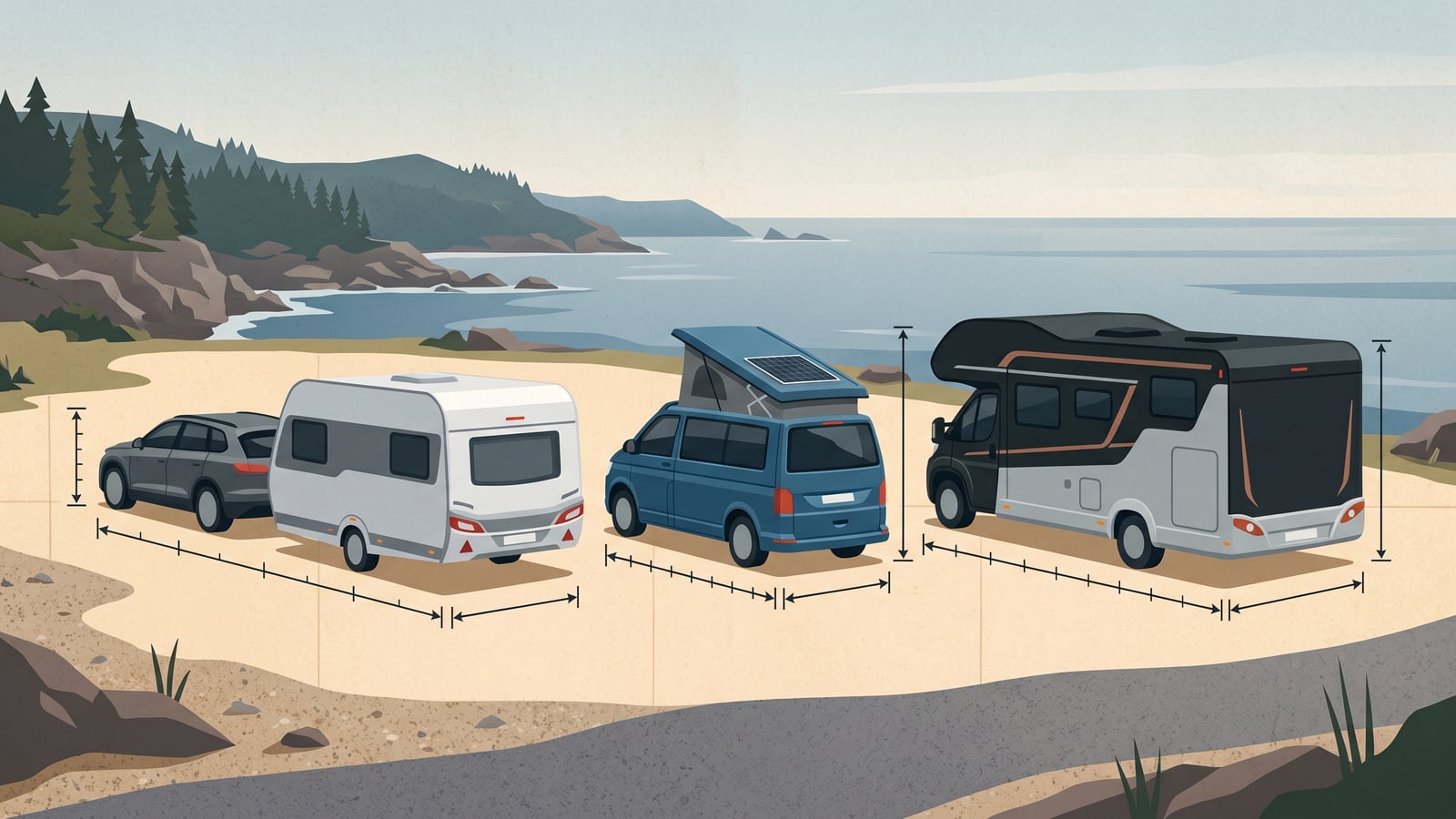
The three common touring setups run into route restrictions in different places. The point below is which restriction each shape tends to trigger in a given fictional comparison — not a ranking of vehicles in general.
A vehicle's own recorded height, width, and length decide which dimensional restrictions it clears — not its general category. In the fictional compact-campervan comparison below, a declared height of 2.65 m clears a fictional 2.80 m tunnel screen with a 0.15 m margin; that Pass covers height only, and width, length, and actual mass for the same stage still need their own separate check.
In the fictional larger-motorhome comparison below, a declared width of 2.42 m fails a fictional 2.40 m bridge screen by 0.02 m — a result that follows from that specific recorded figure against that specific restriction, not from a general rule that bigger vehicles fail more often. Where a dimensional check fails, the response is the same whatever the vehicle's size: reroute or stop. Squeezing through isn't an option.
Towing a caravan means checking a wider set of figures, though the same restriction types still apply. Unhitch the caravan and the tow vehicle moves under its own, separately checked profile — that doesn't remove restrictions, it just swaps which profile you're checking them against. Hitched up, you're tracking five separate figures, and any one of them can fail on its own:
- the tow vehicle's own technical towing limit
- the caravan's plated limit
- the actual combined mass of both together
- the registered combination limit
- whether your licence category covers that combined weight
Tow vehicle and caravan rules in Sweden
In Sweden, when you're towing a caravan, the tow vehicle's own technical rating usually governs, even when the caravan's plate would allow more. If your tow vehicle's rated for a lighter braked trailer than the caravan weighs, its paperwork doesn't get you a pass — the lower figure applies.
Licence category matters too, and these thresholds are based on registered total mass rather than on what the combination actually weighs that day. A standard Category B licence covers a trailer over 750 kg only while the combined registered total mass of car and trailer is at most 3,500 kg. An extended B96 entitlement raises that combined registered total mass ceiling to 4,250 kg. Category BE covers a tow vehicle with a registered total mass of up to 3,500 kg paired with a trailer of up to 3,500 kg. These towing and licence thresholds come from Transportstyrelsen and apply in Sweden; if you're touring the same combination into Finland or Norway, check the governing authority there rather than assuming these Swedish figures carry over.
Build your route-fit profile
Once you have your real figures, put them somewhere you'll use them — a notebook, your phone, or a printed sheet, filled in straight from your registration documents before you plan a route.
If a figure lands exactly on a stated limit — your registered combination mass matching a ferry's posted maximum, say — treat that as unresolved rather than a pass, and get written confirmation from the operator or authority before you rely on it. The number on its own doesn't tell you whether the operator or authority will accept it.
Route-Fit Profile Card
| Field | Your document term(s) | Card label | Your figure | Restriction exact wording & scope | Source & date checked | Result | Confirmation status |
|---|---|---|---|---|---|---|---|
| Overall height | — | Height | ___ m | ___ | ___ | ___ | ___ |
| Overall width | — | Width | ___ m | ___ | ___ | ___ | ___ |
| Overall length (incl. any trailer/caravan) | — | Length | ___ m | ___ | ___ | ___ | ___ |
| Moment-specific weight, as loaded | current loaded mass, confirmed current-mass figure | Actual mass | ___ kg | ___ | ___ | ___ | ___ |
| Statutory ceiling on the registration certificate | permitted gross mass, registered maximum mass | Registered maximum mass | ___ kg | ___ | ___ | ___ | ___ |
| Per-axle limits, if shown | — | Axle limit(s) | ___ kg / ___ kg | ___ | ___ | ___ | ___ |
| Tow vehicle's own actual mass, if towing | — | Tow vehicle actual mass | ___ kg | ___ | ___ | ___ | ___ |
| Caravan/trailer's own actual mass, if towing | — | Caravan actual mass | ___ kg | ___ | ___ | ___ | ___ |
| Combined weight of both, if towing | — | Actual combination mass | ___ kg | ___ | ___ | ___ | ___ |
| Tow vehicle's technical braked-trailer limit | — | Tow vehicle's technical trailer limit | ___ kg | ___ | ___ | ___ | ___ |
| Combined weight the tow vehicle's registration allows | — | Registered combination mass limit | ___ kg | ___ | ___ | ___ | ___ |
| Caravan/trailer's manufacturer plate limit, if towing | — | Caravan plated limit | ___ kg | ___ | ___ | ___ | ___ |
| Classification the operator applies to this combination, if relevant | — | Operator classification | ___ | ___ | ___ | ___ | ___ |
| Licence category held | — | Licence category | ___ | — | — | — | — |
Fictional completed example, single vehicle, for illustration only:
- Height: 2.65 m
- Width: 2.05 m
- Length: 6.20 m
- Actual mass: 3,100 kg
- Registered maximum mass: 3,500 kg
- Axle limits: 1,700 kg / 2,000 kg
- Licence category: B
Fictional completed example, car-and-caravan combination, for illustration only:
- Tow vehicle actual mass: 2,300 kg — feeds into the actual combination mass below; not itself compared against a stage restriction
- Caravan actual mass: 1,700 kg — feeds into the actual combination mass below, and stays under both the caravan plated limit and the tow vehicle's technical trailer limit
- Actual combination mass: 4,000 kg — checked against a fictional ferry operator's stated 4,000 kg combination-mass maximum for that lane, checked 10/06/2026 (fictional date): an exact match, so the result is Unresolved rather than a Pass
- Tow vehicle's technical trailer limit: 1,800 kg (braked) — the caravan's 1,700 kg actual mass stays within this limit
- Registered combination mass limit: 4,300 kg — the 4,000 kg actual combination mass stays within this limit
- Caravan plated limit: 1,900 kg — the caravan's 1,700 kg actual mass stays within this limit, though the lower 1,800 kg tow-vehicle technical limit is the one that actually governs
- Operator classification: standard car-and-caravan ferry lane — determines which stated maximum applies
- Licence category: unresolved — the Category B, B96, and BE thresholds above are based on each vehicle's own registered total mass, not the actual masses recorded here; add the tow vehicle's and trailer's registered total mass figures before checking which category actually covers this combination
The middle column is there because your paperwork may not use "actual mass" or "registered maximum mass" word for word — Norwegian, Finnish, and Swedish documents phrase things differently, and English translations vary again. Whatever the label on the page, match it to whichever of the two fields it measures: a moment-specific loaded weight, or a fixed statutory ceiling.
Evaluate stages against route restrictions
With the profile filled in, work through your route one stage at a time. This is a planning filter you fill in before departure. It isn't a certification that a stage will be clear on the day you drive it — road conditions, works, and local signage can still change things in between.
Per-stage restriction log
| Stage | Restriction type | Restriction wording & scope | Source | Checked | Your figure | Limit | Exception or uncertainty | Result | Confirmation status | Action |
|---|---|---|---|---|---|---|---|---|---|---|
| Fictional Stage A — rural bridge, compact campervan | Width | "Max width 2.40 m" sign for this bridge only | Local road signage (fictional) | 03/06/2026 (fictional) | 2.05 m | 2.40 m | None noted | Pass | Not applicable | Width passes; check height, length, and mass for the same stage separately before it counts as clear |
| Fictional Stage B — rural bridge, larger motorhome | Width | "Max width 2.40 m" sign for this bridge only | Local road signage (fictional) | 03/06/2026 (fictional) | 2.42 m | 2.40 m | None noted | Fail | Not applicable | Reroute before reaching the bridge |
| Fictional Stage C — ferry lane, car-and-caravan | Combination mass | Stated maximum combination mass for this lane only | Ferry operator (fictional) | 10/06/2026 (fictional) | 4,000 kg | 4,000 kg | Exact match to stated ceiling | Unresolved | Pending — written confirmation requested (fictional) | Get written confirmation from the operator before booking |
| Height | ||||||||||
| Length | ||||||||||
| Registered maximum mass | ||||||||||
| Axle load |
Mark each row Pass, Fail, or Unresolved. A Fail or an Unresolved row needs an action before the stage goes into your itinerary — a reroute, a call to confirm a limit, or a decision to drop the stage altogether.
Official national road channels and data limits
Each country publishes a live channel for road conditions and restrictions — and each one has its own gaps.
Finland's Fintraffic Traffic Situation service reports disruptions, road weather, and condition-caused weight restrictions, but its own displayed accuracy depends on weather, roadside equipment, and data transmission, so treat it as a live aid rather than a guarantee.
Sweden's Trafikverket road map shows incidents, works, and restricted height and bearing capacity layers, but it doesn't include northern winter bearing information (vinterbärighet); for that you need the separate NVDB på karta service.
Norway's Statens vegvesen traffic app gives alerts, webcams, and mountain-pass status, and its axle-load, height, length, and legal-routing functions are built specifically for heavy vehicles rather than as a general clearance check for every touring vehicle.
Check whichever service applies to your route again close to departure — conditions can shift between planning and arrival.
Three hypothetical comparisons
These three scenarios are fictional, built to show how the method plays out rather than to measure any real vehicle. No vehicle testing or fieldwork stands behind the figures.
A compact campervan, a height check. The card lists height as 2.65 m. A tunnel ahead is signed at 2.80 m. That's a 0.15 m margin — a Pass on height. This result covers height only — width, length, and mass on the same stage still need their own separate check before it counts as clear.
A larger motorhome, a width check. The card lists width as 2.42 m. A rural bridge on the planned route is signed at 2.40 m — a 0.02 m shortfall. Folding the mirrors in or edging across isn't a workaround for a width restriction like this. The result is a Fail, so the detour needs planning before the driver reaches the bridge rather than at the last moment.
A car-and-caravan combination, an exact match. The tow vehicle's actual mass is 2,300 kg, the caravan's is 1,700 kg — a combined 4,000 kg. The ferry operator's stated maximum for that lane is also 4,000 kg. Because the combination's actual mass lands exactly on the operator's stated ceiling, the result is Unresolved rather than a Pass, and the next action is written confirmation from the ferry operator before departure.
What to do when a metric fails the check
A Fail or an Unresolved result narrows down to a few honest responses:
- get written confirmation from the operator or authority
- reroute around the restriction
- change what you're carrying so the actual figure changes
- stop and pick a different stop for the night while you sort it out
What doesn't belong on that list is rounding a figure down to make it fit, or assuming a restriction won't be enforced. A restriction that's off by two centimetres, or a mass reading that's unresolved by a kilogram, is still a restriction — the size of the gap doesn't change what you do about it.
Where to go next
This guide sits in the Vehicles and Equipment topic hub, alongside the route and ferry vehicle-profile verification guide, which goes deeper into matching a single confirmed profile to a specific booking. If you still need to choose between a campervan, motorhome, caravan, or car for the trip in the first place, this comparison of touring setups is the right starting point. Once your route is shaped around a vehicle you trust, the Roads, Rules and Borders hub covers the document, toll, and border checks that sit alongside size and weight on a cross-country trip. The wider Road Touring section covers everything else involved in planning the journey.
Your next step: take out your vehicle's registration certificate — Part I in Finland, Part 1 in Sweden, or your Statens vegvesen registry lookup in Norway. Copy your exact height, width, length, and registered maximum mass into the Route-Fit Profile Card above, along with your current actual loaded mass, before you check a single stage restriction.