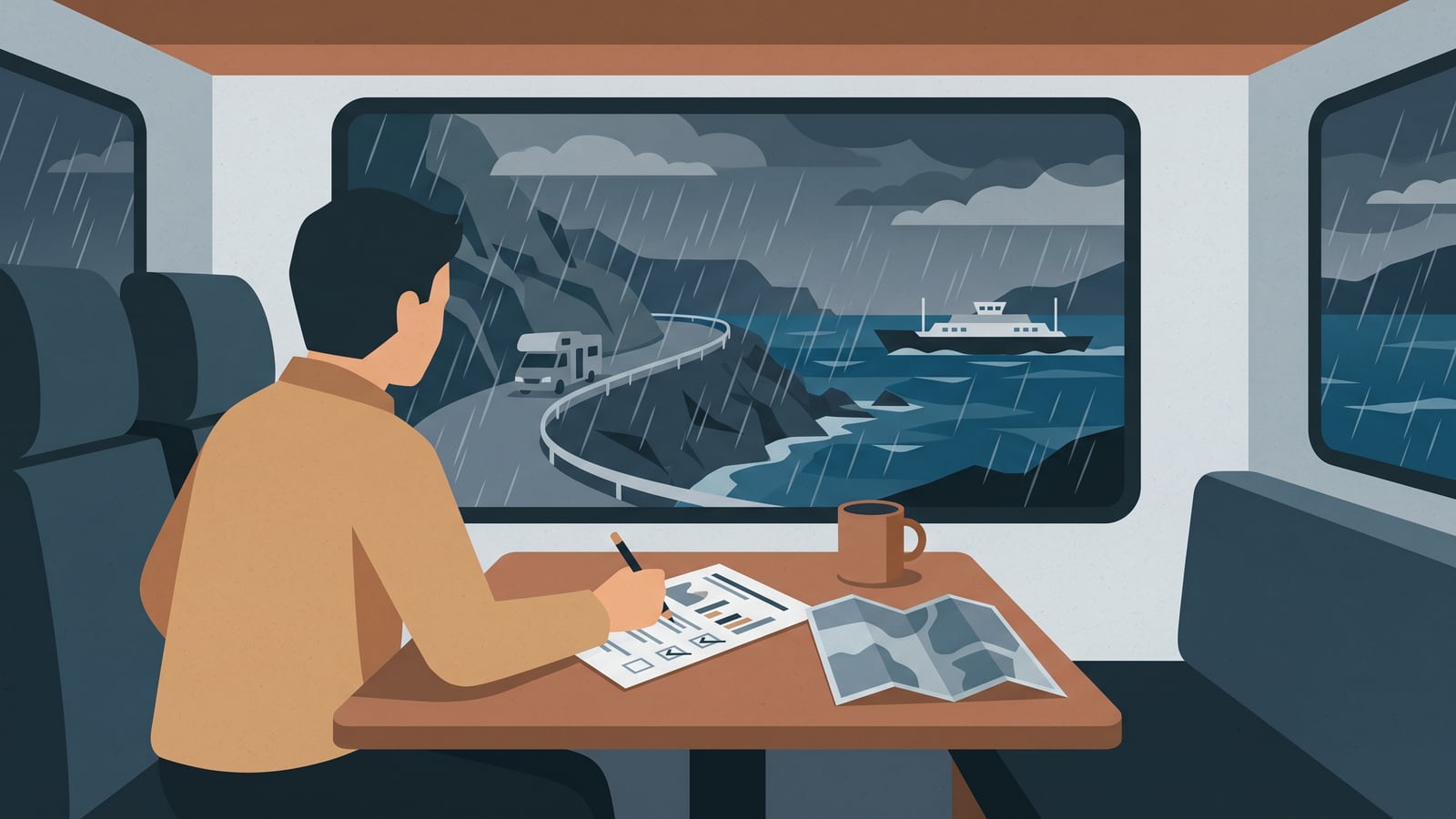
The plan must be able to change
An itinerary tells you what you intend to do: drive this road, reach that stop, catch this ferry. It doesn't tell you what happens when the weather turns, a road closes, a sailing is delayed, or you run out of alertness before you run out of daylight. A contingency-ready plan adds four things an itinerary leaves out: what might change, a point at which you'll stop and reconsider, two workable alternatives, and a condition that overrides the schedule no matter how good the original plan was.
Waiting, shortening the day, rerouting, or abandoning a stage aren't failures. They're planned outcomes you decided on in advance, before pressure to keep to the itinerary took the decision out of your hands. That's the structure this guide walks through: a stage card you fill in for one material part of your trip. It's a desk-based Beyond Bothnia planning method for private campervan and motorhome touring — not a live go/no-go service. It organises preparation; it doesn't make the decision for you when the day arrives.
If you're touring with a caravan, a car, or a motorcycle, the same structure works, but you'll need to supply your own combination's constraints rather than borrow a motorhome's. More on that below.
Build one stage at a time
A whole multi-day tour is too much to hold contingencies for at once. Break it into material stages — a border crossing, a mountain pass, a ferry check-in, a long day ending at a booked site — and build one card per stage that carries real risk. For each stage, work through the same order:
- What you intend to do, and what you're committing to by doing it (a booking, a check-in time, a route with few alternatives).
- The constraint — about your vehicle, your contract, or your travelling party — most likely to turn a workable plan into an unworkable one.
- The inputs that could change between now and the stage: weather, road status, an operator's schedule, delay stacking up earlier in the day, and how alert the driver is.
- A decision point — a place or moment where you'll check those inputs again, set early enough that you still have real choices left.
- Two bounded fallbacks, chosen in advance, plus the condition under which you don't start or don't continue at all.
That's the whole method. The rest of this guide fills in each part.
Name the commitment and constraint
Start with what the stage commits you to. A ferry check-in commits you to being at a terminal by a fixed time. A booked overnight commits you to a specific arrival window if the booking has a latest-arrival or cancellation condition — check the actual current term rather than assuming one applies. A mountain crossing with no realistic alternative commits you to that specific road being usable. Write the commitment down plainly — it's the thing a fallback has to either preserve, delay, or release.
Then name the constraint most likely to turn that commitment sour. For a motorhome or campervan, that's often something concrete: a height or width limit that rules out one detour, a fixed departure time from a rental contract, a co-traveller or pet whose comfort sets the real limit on how long a delay is tolerable. Accumulated delay matters here too — a stage that looked comfortable earlier in the day can look tight later if earlier stops ran long, and the stage card should treat that stacking delay as an input worth checking as the day goes on.
Separate the changing inputs
It helps to stop treating "disruption" as one vague worry and instead name the separate things that can change:
- Weather — can shift the safety and comfort of a route between when you plan and when you drive it.
- Official road status — closures, restrictions, or roadworks announced by the authority responsible for that road.
- Operator disruption — a ferry, for instance, that's delayed, rescheduled, or cancelled.
- Accumulated delay — the gap between the planned schedule and where you are in the day.
- Driver readiness — how alert the driver is, which changes through the day regardless of what the map says.
Driver readiness deserves the same weight as the other four. Check it repeatedly through the day, since alertness can change as the day goes on — the evidence for that is covered below. Each of these five inputs can change on its own schedule and may point toward a different fallback, so it's worth checking them separately rather than assuming one clear day means the whole stage is fine.
Choose the decision point
Set the decision point before the last practical branch — the last junction where a different road is still realistic, the last moment you could still cancel a booking without penalty, the last spot with a suitable place to stop and wait. There's no universal distance or time that works for every stage; one on a coastal road with frequent turn-offs looks different from one on a single road through open country with nothing between towns. What matters is setting it early enough that reconsidering is still a real choice, before it turns into a formality on the way to what you'd already decided.
Use your actual setup
The stage-card structure isn't specific to motorhomes, but the constraints you feed into it are. If you're towing a caravan, treat the tow vehicle and caravan as one combination rather than assessing either part separately. Bring your licence category, ferry classification, and your ability to reverse or turn if a road doesn't work out to the same decision. If you're touring by car, your accommodation, weather exposure, and rest needs will look different from a motorhome's onboard systems, and your fallback stops need to match that. On a motorcycle, factor in your own weather exposure, rest needs, licence, accommodation and riding limits — and don't treat another rider's tolerance as a safe general limit. Whatever the vehicle, bring your own licence, contract, and operating limits to the card rather than assuming a campervan example transfers unchanged.
Four bounded choices
Once a stage looks uncertain, you're choosing among four things: wait, shorten the day, reroute, or abandon the stage. None of them is the right answer by default — each preserves something different, costs something different to arrange, and has its own condition that makes it a poor fit.
| Choice | What it preserves | Immediate consequence to arrange | Poor-fit trigger |
|---|---|---|---|
| Wait | The original route, kept open as a later option | Time, and possibly a booking or overnight change | No suitable place to wait, or waiting encourages rushing later |
| Shorten | Part of the day, with the rest deferred | A new stop, possibly a changed booking | No verified stop, or reaching it still needs more driving than is safe |
| Reroute | The destination, by another path | Checks on the new road, vehicle fit, and timing | Alternative can't be confirmed, or driver is already tired |
| Abandon | Neither — releases the stage entirely | Contacting the operator, replanning the next stage | Used before checking a simple, resolvable update |
Wait or shorten
Waiting keeps the original plan alive. You find somewhere suitable to pause, and you give the weather, the road authority, or the ferry operator time to publish an update before you commit either way. It works well when there's a genuinely suitable place to sit and the uncertainty is the kind that resolves — a forecast that's expected to clear, an operator that's said a decision is coming. It works badly when there's nowhere sensible to wait, or when waiting quietly turns into chasing the clock later, trading a calm decision now for a rushed one in a few hours.
Shortening the day means picking an earlier, lawful, suitable stop and deliberately leaving the rest of the stage for another day. It reduces what you're still committed to today and can be arranged without inventing an unfamiliar detour. Shortening may require changing a booking or arranging another stop, and the unfinished stage still needs to go somewhere in a later plan. It's a poor fit if the stop you're aiming for hasn't been checked, or if reaching even that shorter stage still asks the driver to push past being genuinely ready to continue.
Reroute or abandon
Say you're touring in Norway and the road you'd planned to take is affected, and a mapping app quietly starts showing you a different road instead. That alternative still needs checking before you follow it. Rerouting can preserve the destination without waiting for the original road to reopen, but it introduces its own checks: who's responsible for that road — national, county, or municipal authorities split this differently — whether your vehicle fits it, and what the new timing and stops look like. An absent notice about the alternative doesn't establish that it's open, unrestricted, or suitable for your vehicle. Rerouting is a poor fit when you can't confirm the alternative's status or your vehicle's fit on it, or when the driver is already tired enough that a new, unfamiliar road adds risk rather than removing it.
Abandoning the stage means releasing it rather than trying to rescue it. It takes the pressure off finding a way to make the original plan work today, and it opens space to contact the operator and rebuild the next stage properly. The cost is that a booking may be lost or need changing, and you may need to find alternative accommodation you hadn't planned for. It's a poor fit if you reach for it before checking a simple update that might have resolved things, or if the place you're proposing to stop instead hasn't itself been verified as suitable.
Readiness overrides the itinerary
The European Road Safety Observatory treats fatigued driving as an important road-safety risk, while also noting that fatigue has no single agreed definition and that measuring it at scale has real limits. As UK guidance, the Highway Code says not to begin a journey when you're tired, and to stop in a safe place if sleepiness develops while driving. The Highway Code also says, in Rule 97, that drivers should plan their route and allow sufficient time for breaks and possible delays — again UK guidance, not a claim about requirements elsewhere. That's one country's rule, clearly labelled as such — it isn't a claim about law everywhere you might tour.
Beyond Bothnia treats tiredness or sleepiness as a conservative editorial stop condition: if it shows up, you stop when it's safe to do so, and no itinerary, booking, or plan overrides that. This is a judgment call the article is making deliberately, and there is no universal numeric threshold behind it — no stated hour count or distance that makes someone definitely fine or definitely unfit to continue. Separately, European material on driving-time rules for professional lorry, coach and bus drivers describes rules built for that working population; it does not establish a private-touring threshold, and it doesn't mean no other national rules for private drivers exist elsewhere.
Your contingency-stage card
The card below organises your preparation for one stage. As already noted, it can't make a live go or no-go call for you, and confirming current road, booking, vehicle-fit and safety status still depends on the checks covered in the last section.
STAGE CARD

Primary stage and material commitment:
Vehicle or traveller constraint that changes the decision:
Decision point:
Live information source(s):
Trigger or unresolved condition:
Fallback A:
Fallback B:
Booking or contact consequence:
Stop/no-go condition:
Next decision point:
A completed ferry-stage loop
Every name, place, road and time below is invented for teaching purposes. None of it is a measured, recommended, or universally safe or legal option, and none of it is established as available or suitable for another journey — it shows how the fields connect, nothing more.
Primary stage and material commitment: Reach the evening ferry crossing at Rautaranta; check-in closes at an operator-set deadline before sailing.
Vehicle or traveller constraint: Motorhome party of two; driver fatigue is the limiting factor after a long earlier stage.
Decision point: The last useful junction before the terminal, where a coastal detour is still possible.
Live information source(s): The relevant weather and road authority for that stretch, and the ferry operator directly for sailing status.
Trigger or unresolved condition: Worsening weather and a road notice near the junction make the route's status unclear.
At the decision point, the party checks both sources. Neither has resolved: the forecast is unchanged and the road notice still doesn't say whether the road is passable. Rather than push on and chase the check-in deadline, their first choice is to confirm that a previously identified place to wait is still currently available, permitted and suitable for the conditions, and then wait there. That's why setting it early pays off: waiting here still leaves real options.
Later, the road notice is still unresolved and the weather is unchanged. The party interprets this as the uncertainty not clearing in time to reach check-in safely, so they move to Fallback A. They confirm that a previously identified stop short of the terminal is still currently available, permitted and suitable for the vehicle and conditions. They shorten the day to that stop. They also contact the ferry operator to explain the delay and ask what happens to the booking. The operator's answer — whether that means rebooking, a fee, or missing the sailing — depends on the current notice and ticket terms for that booking; this card can't promise which one applies.
If the operator has no workable later sailing and the road still isn't confirmed passable the next morning, the party moves to Fallback B: they abandon that crossing entirely and contact the operator to discuss the booking and their onward options from the shortened stop.
Stop/no-go condition: If the driver becomes sleepy at any point in this sequence, that overrides everything above — stop when it's safe to do so rather than continue toward the booking.
Next decision point: Only once the driver is genuinely rested and the weather and road information have been checked again.
On some ferry routes covered by EU ship-passenger rules, a cancelled or significantly delayed sailing can bring conditional rerouting, reimbursement, or information obligations for eligible journeys — scope and exclusions apply, cruises are treated differently from other sailings, and any accommodation obligation carries its own severe-weather limitation. None of that guarantees a particular outcome for this booking. The operator's own notice and ticket terms govern the immediate sailing and booking details, and they're what to check first.
Verify the changed plan
Preparing the card is only the first pass. Identify the sources that govern your stage while you're still planning, then check them again before you leave and recheck at the decision point you set. Repeat the route, vehicle, contract and operator checks whenever the plan changes. Three sources matter here, and more than one may apply depending on the actual place, road, and journey: the current meteorological and road authority responsible for the actual jurisdiction and road owner; the actual ferry operator for sailing status and booking terms; and local authorities or emergency services if there's an immediate hazard or an official instruction in play.
This method doesn't cover technical repair, recovery or towing. It also doesn't cover electrical, gas or fuel issues, or unsafe roadside procedures. Direct a defect, warning light, alarm, leak or damage to the exact manual. Your rental provider, roadside assistance or a qualified service can also help. Treat any unfamiliar vehicle condition the same way.
In Finland, the Finnish Meteorological Institute publishes local, time-specific weather warnings. Fintraffic covers road conditions, disruptions, roadworks, forecasts and restrictions for the roads its service tracks — though Fintraffic itself notes that observations can be missing or inaccurate, and that actual conditions may differ from what's shown. In Norway, the Norwegian Public Roads Administration's traffic-information channels cover national and county roads; municipal roads are a separate responsibility. This method covers weather, road status, ferry disruption and driver fatigue for private touring stages, within the sourcing and jurisdiction limits described above.
Where to go next
This article sits in the trip-planning hub, alongside guidance on leaving breathing room in a road-trip itinerary so a single delay doesn't cascade through the rest of the days, on planning a comfortable day on the road so the pace itself doesn't create the pressure this card exists to defuse, and on deciding what to book and what to leave flexible before you commit to anything a stage card would later need to unwind. For the wider set of planning, vehicle, and rules guidance this sits within, see the road-touring section.
Your next step: Complete the stage card for the first material stage of your intended journey, beginning with its decision point.