Your car's tyre rule doesn't automatically apply to your motorhome. Sweden's rule doesn't carry over into Norway. And the plan you'd make for a slow-moving queue at a mountain pass isn't the plan you need if the crew turns you away. Winter touring across these two countries rewards drivers who check the actual document, the actual vehicle, and the actual authority for their specific route and vehicle.
This is a verification method and a working checklist, not a live go or no-go call. Only the road authority's current status, your vehicle's own paperwork, and your judgment on the day can tell you whether a specific stage is safe to drive.
Pre-departure winter road and convoy checklist
Work through this in order. Each step sets up the next, so skipping ahead usually means backtracking once you hit a rule you didn't expect.
- Vehicle registration and hardware check. Pull out your registration document and note its exact Maximum Authorised Mass (MAM), key dimensions, your tyres' winter markings, and your measured tread depth. Check whether your vehicle, country, and expected conditions require you to carry chains, and confirm any chains you carry fit your actual tyres and that your rental contract or vehicle manual permits winter driving, chain fitting, and the route you have in mind. Confirm the vehicle's condition too — no unexplained warning lights, damage, or defects — before you rely on it for a winter stage; if a warning, defect, or unfamiliar condition can't be resolved, check the vehicle manual or contact your rental provider, roadside assistance, or a qualified service rather than diagnosing it yourself.
- Swedish live checks. Open Trafikverket's traffic information service for road status, incidents, and any active convoy notices. Then check SMHI separately for weather warnings — the two cover different things, and neither one stands in for the other.
- Norwegian live checks. Open Statens vegvesen's traffic portal or call 175 (+47 22 175 175 from abroad) for road and mountain-pass status, check Yr for the weather forecast, and check Varsom for avalanche, landslide, or flood warnings.
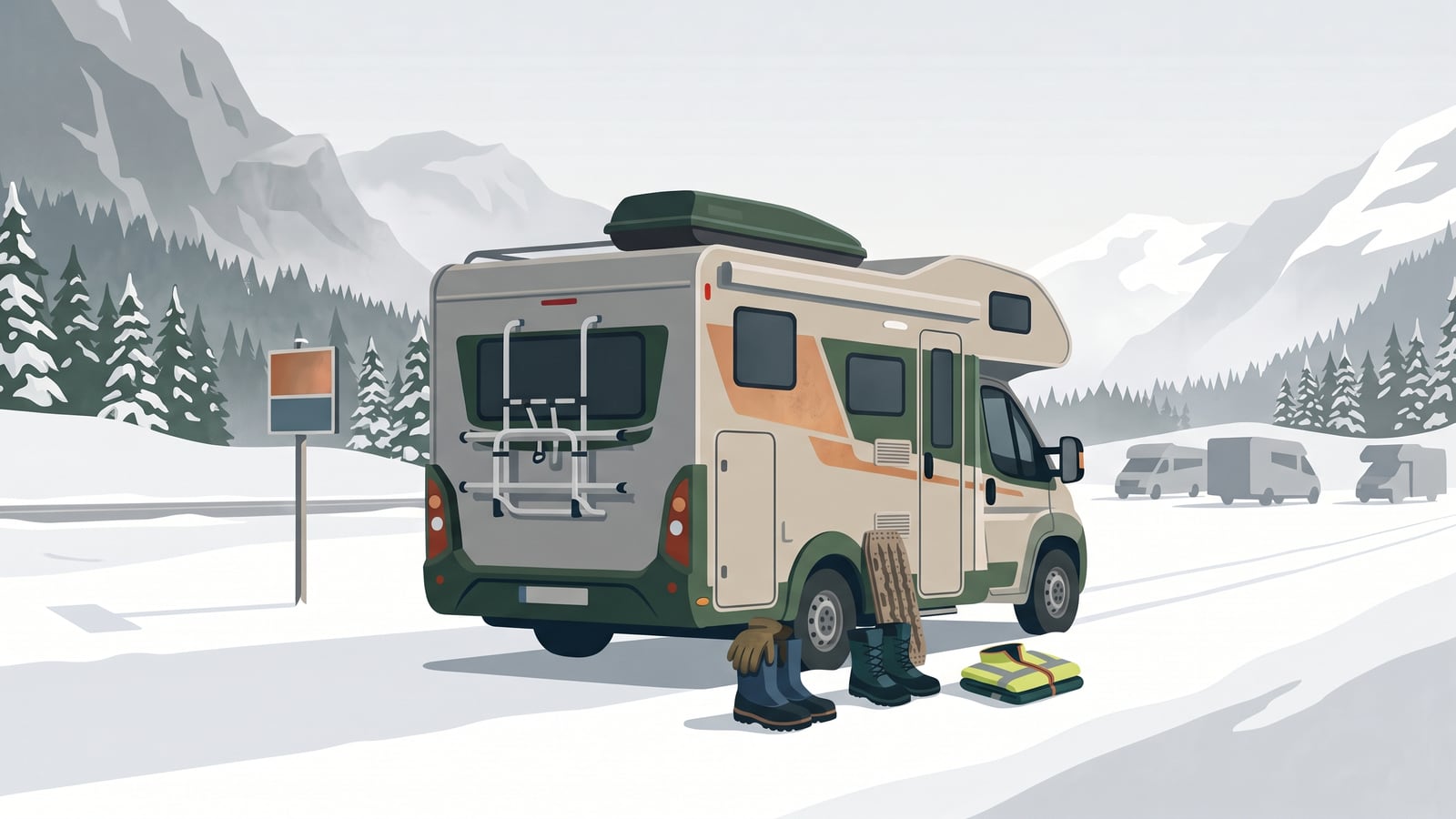
- Mountain convoy readiness. Before you approach a Norwegian convoy point, top up your fuel tank or fully charge the traction battery. Keep your cold-weather gear inside the cabin where you can reach it without stepping outside: warm clothing and boots, a torch, tow rope and snow shovel, plus food and something hot to drink.
- Convoy branches. If you're just waiting in a slow-moving queue, keep a checked backup route or overnight option in mind, and be patient. If the crew refuses admission, that's a different situation, and — as our editorial safety judgment — the right response is to use a previously checked alternative route, return, or postpone, not to linger at the barrier or attempt the crossing anyway; the fuller reasoning follows below.
- Roadside breakdown protocol. When it's safe to do so, move people clear of moving traffic to a protected place, following any current police or road-authority instruction on scene. Only place a warning triangle if you can reach the required spot without stepping into moving traffic: in Sweden, that's at least 100 metres behind the vehicle wherever the speed limit exceeds 50 km/h; in Norway, a safe distance, if possible at least 150 metres, when the vehicle blocks or endangers traffic and can't immediately be moved (Norway also requires a reflective vest on board for specified vehicle classes — details below). Then know which number gets you an emergency response, which gets you a road-condition report, and which gets you a private recovery truck. Don't continue if anything above can't be confirmed, or if an official closure, warning, or barrier applies to your route.
Verifying vehicle mass, tyres, and chains
Sweden and Norway both tie their tyre rules to vehicle mass, but the mass bands don't line up. The easiest mistake here is reading the wrong country's rule, or assuming a light-vehicle rule covers a heavier motorhome.
Here's Sweden's actual rule: the winter tyre requirement covers private car class I, private car class II campers, light trucks and light buses up to 3,500 kg maximum authorised mass, plus their trailers: tyres must be Alpine-marked (3PMSF) or studded and have at least 3 mm of tread depth whenever wintry road conditions are present on any part of the road, from 1 December to 31 March, as determined by police. If your motorhome sits above that 3,500 kg line, this rule doesn't tell you what applies to it — confirm the exact classification directly with Transportstyrelsen and your own registration documents before you rely on it.
Norway draws its own line, and it sits higher, with two separate exceptions built into it. Motorhomes over 3,500 kg and not exceeding 7,500 kg are exempt from the fixed winter-tyre-marking requirement set for heavier vehicles; what still applies to this band is a minimum tread depth — at least 3 mm during the winter period (1 November to the first Sunday after Easter Monday across most of the country, 16 October to 30 April in Nordland, Troms, and Finnmark) and at least 1.6 mm the rest of the year. Meeting that minimum doesn't guarantee enough grip in every condition, so fit chains or otherwise secure adequate grip whenever conditions call for it. The same weight band is also exempt from carrying at least three chains, the fixed quantity required of heavier vehicles, but drivers must still carry chains when snow or ice is expected on the road ahead.
Whichever vehicle you're driving, go by its documented MAM, not its model name or class label, and check each country's current rule separately: passing a Swedish light-vehicle check tells you nothing about what Norway requires. If you're renting, the MAM on the assigned vehicle's registration document is fixed, but your actual loaded mass moves with what you pack — and that loaded mass has to stay under the documented limit. Confirm both figures, the document's MAM and your provider's own weight and loading terms, directly against the vehicle you're assigned; a class name alone doesn't settle it.
Checking live road and weather status across borders
Road status and weather warnings answer different questions. Treating one as a stand-in for the other is how drivers get caught out — a road can stay open with a storm warning in effect, or close for maintenance on a perfectly clear day.
In Sweden, check Trafikverket's traffic information service for closures, roadworks, incidents, and convoy notices. Check SMHI separately for its colour-coded warnings — yellow, orange, or red — since those are issued independently of the road network's own status. In Norway, Statens vegvesen runs the equivalent road and mountain-pass service through its portal, app, and phone line. MET Norway handles the general forecast through Yr, and works with NVE through Varsom on avalanche, landslide, and flood warnings specifically. If you spot a defect on a municipal road rather than a state highway, report it to the local municipality rather than the national traffic centre.
Build the habit of checking both sources for each country before a winter stage — whichever app loads first on your phone isn't enough on its own.
Preparing for and driving a Norwegian mountain pass convoy
Some Norwegian mountain roads only open when a snowplough leads a group of vehicles through together — kolonnekjøring, or convoy driving. Before you queue for one, prepare as if you might sit still for a while in the cold: fill the fuel tank or fully charge the traction and starter battery, and keep your winter gear — warm clothing and boots, a torch, tow rope, and snow shovel, plus food and a hot drink — somewhere you can reach without leaving your seat. A convoy wait can run longer than you'd expect, and gear stashed in an outside locker does you no good once the queue starts moving.
Before you join and handling admission or refusal
The snowplough crew decides who joins the convoy, and that decision isn't automatic. They can turn away a vehicle for inadequate winter tyres, poor mechanical condition, or passengers dressed unsuitably for the conditions, and the group's overall size is capped by how many people the rescue vehicles on hand could actually carry if something went wrong. None of that is negotiable at the barrier.
Waiting in line and being turned away call for different responses, and mixing them up is where trouble starts. If the queue is just moving slowly, keep a backup route or overnight option in mind for a long wait, and be patient. Being turned away is a different situation, and how you respond to it is our editorial safety judgment rather than an official Statens vegvesen procedure: if the crew refuses admission, use a previously checked alternative route, return to shelter, or postpone the crossing rather than lingering at the barrier hoping the decision changes.
Driving in the column
Once you're moving, the discipline is straightforward but non-negotiable. Switch on your hazard flashers and any fitted fog lights, keep the vehicle ahead in sight, hold a steady speed, and stay in line — no turning around, no pulling out to pass. If the convoy stops, stay with the vehicle and follow the crew's instructions rather than stepping out to look. In freezing temperatures, point the windscreen's cold-air setting at the glass rather than warm air, using your own vehicle's controls and manual.
Managing a winter breakdown safely
A winter roadside stop means two separate jobs: keeping people safe, and making the vehicle visible to other traffic. Which one comes first depends on the road you're actually on — its geometry, the traffic moving past, and any instruction from the police or road authority on scene. Don't attempt roadside repairs, jacking, or a tyre change while exposed to moving winter traffic; where the situation genuinely allows it, move everyone to stable ground away from the carriageway.
Where you place a warning triangle depends on which country you're in, and the two rules don't match. In Sweden, place the triangle at least 100 metres behind the vehicle whenever the road's speed limit exceeds 50 km/h, adjusting further back if sightlines are poor; in Norway, when the stopped vehicle creates danger or obstruction and can't immediately be moved to a suitable place, place it at a safe distance and, if possible, at least 150 metres back. Place it only if you can reach that spot without walking into moving traffic, and follow current police or road-authority direction if that makes it unsafe — check Trafikverket's own breakdown guidance and the Norwegian vehicle-use regulation directly rather than assuming either distance covers both countries. Norway also requires carrying a reflective vest in the specified vehicle classes; the rule we found covers having it on board, not a standing requirement to wear it, so confirm your own obligation against the current regulation if that distinction matters to you.
Once people and the vehicle are both accounted for, what you do next depends on what's actually wrong. The Swedish and Norwegian road-authority numbers — Trafikverket's traffic customer service and Statens vegvesen's 175 line — are for road information and traffic reports, not vehicle recovery; for a genuine emergency call 112 in either country, and for a mechanical breakdown contact your own private recovery or rental assistance provider. Trafikverket's traffic customer service can be reached on +46 771 921 921. In Norway, non-emergency incidents that still need police attention go through 02800 rather than 175.
Where to go next
This checklist sits in the road-touring vehicles-and-equipment hub, alongside guides on how vehicle size and weight shape your route, a two-layer routine for pre-departure and daily vehicle checks, and tyres, roads, and conditions for a Nordic winter road trip. If your winter stage depends on rescue or towing cover, insurance and breakdown questions to ask before you leave is worth reading too. From there, the broader road-touring section covers the rest of the planning discipline this checklist assumes.
Your next step: pull out your vehicle's registration document and copy down its exact Maximum Authorised Mass.