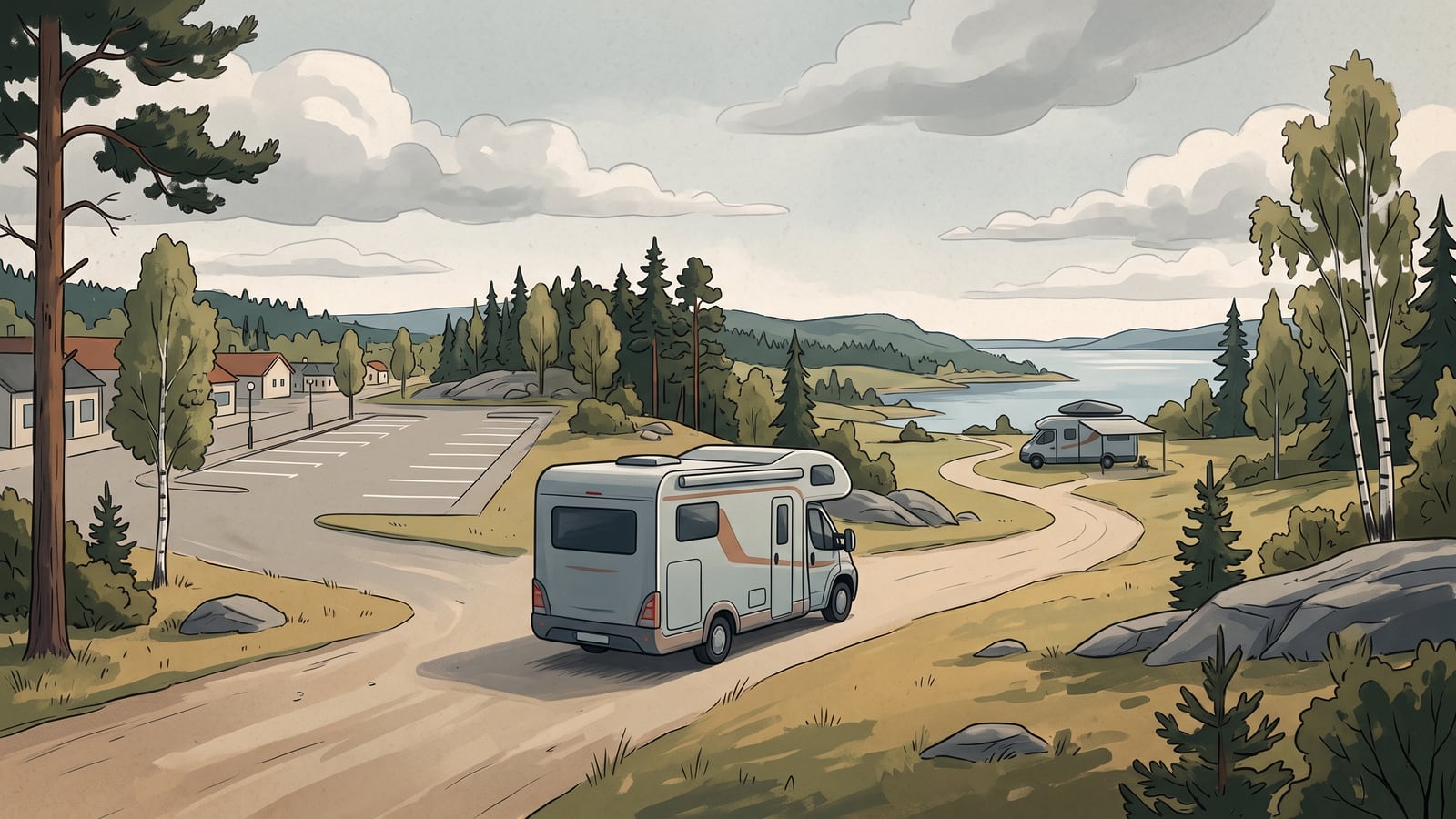
Being allowed to park doesn't mean you're allowed to sleep there. And a row of occupied motorhomes tells you nothing about what the rules permit.
For campervan, motorhome, and car-and-caravan travellers, the real question isn't parking versus camping as categories. It's whether the current terms at this specific spot cover what you plan to do. That depends on four things: the place, the permission, how long you're staying, and how you behave once you're there.
The sources checked here don't offer one shared cross-border rule about staying a set number of hours or avoiding a particular item. Permission is local. You can't read it off common practice, the absence of a visible sign telling you otherwise, or what the vehicle next to you is doing.
The short answer
Start by describing what you intend to do. The location's label doesn't settle the choice.
| Question | Brief parking stop | Overnight or camping spot |
|---|---|---|
| What you're doing | A short rest, meal, walk, or similar stop, within the posted terms | A planned stay whose rules expressly cover sleeping or camping |
| Can you sleep there? | Don't assume it — parking permission and sleeping permission are separate | Should be stated in the current rules |
| Space around the vehicle | Stays inside your bay, no outdoor setup | Depends on the site rules |
| Services | Don't expect any | May be available — confirm before relying on them |
| Best fit for | A quick stop with little setup | An overnight stay, or anything needing permitted facilities or extra space |
Neither option is automatically cheaper, safer, freer, or more legal. A car park can be exactly right for a short stop and completely wrong for sleeping. An overnight site can allow sleeping while restricting specified outdoor equipment such as seating, washing lines, or awnings.
So the question to ask isn't "parking or camping" — it's: do the current terms cover what you're planning?
When a brief parking stop makes sense
Brief parking works when you want a short stop and can keep the whole visit inside the parking conditions: your vehicle or tow combination is eligible, it fits the space, and you're using it for the stated purpose within the time limit.
That covers a meal, a walk, or a rest before you carry on. You pull in, use the place for what it's meant for, and leave before the limit's up. Simple.
But parking permission is narrow. It may say nothing about sleeping, staying overnight, using facilities, or putting anything outside the vehicle. A generous time limit doesn't answer any of those questions on its own.
Look for somewhere else if:
- you plan to sleep there and can't confirm that's allowed;
- your vehicle or full car-and-caravan combination doesn't meet the stated size or eligibility limits;
- you need an awning, furniture, extra space, or campsite-style facilities;
- what you're planning to do goes beyond what the parking terms clearly cover.
There's no shared threshold in the sources at which parking tips over into camping. Staying inside the vehicle, skipping the awning, or leaving by a certain hour might matter under one authority's rules — but none of that adds up to a rule you can carry across borders.
When an overnight spot makes more sense
If sleeping is part of the plan, look for a place whose rules say so. The advantage is clarity: you know the use you intend is covered.
But the details still vary. One place might allow sleeping only if you stay inside the vehicle's footprint. Another might offer a proper pitch where a bigger outdoor setup is fine. Eligibility, tickets, bookings, arrival conditions, and whether space is even available on the night can all affect whether it works for you.
Keep these questions separate:
- Is sleeping or staying overnight permitted?
- Does your vehicle or tow combination qualify, and will it fit?
- Can you use space outside the vehicle?
- Are the services you need there?
- Does the place meet your own access requirements?
A place can say yes to the first question and no to the third. Blackpool Council, for instance, allows sleeping at its named motorhome parking spots but prohibits specified outdoor equipment, including seating, washing lines, and awnings. That's a local rule, not a general definition of what counts as camping.
If all you need is somewhere to sleep and you can live with those limits, a restricted overnight spot might suit you fine. If you want chairs, an awning, or more room, look for a camping option whose rules allow that.
How the choice changes a stop
The distinction gets clearer once you picture how it plays out. The following hypothetical situations show how the same four questions apply.
An evening rest
A motorhome traveller pulls into a signed car park in the evening. They just want a short rest, no outdoor setup, and plan to leave before the time limit runs out.
They read the sign, check the motorhome qualifies, and note the time limit. If the terms cover what they're planning, a brief parking stop is the right call.
A few other motorhomes are already there overnight. That proves nothing about whether sleeping is allowed. If the traveller decides to stay the night and can't confirm it's permitted, they move on to the alternative they'd already checked.
The vehicle hasn't changed. What they're doing has.
Sleeping with an outdoor setup
Two travellers plan to sleep in their motorhome and also want to put out an awning and chairs.
They find a spot whose current rules allow overnight sleeping — but say nothing about the outdoor setup, or actively rule it out. Blackpool's named motorhome locations show how terms can be specific: sleeping is allowed, while seating, washing lines, and awnings are prohibited.
So they've got two real options: keep everything inside the vehicle and stick to the overnight terms, or move to a camping spot that permits the bigger footprint. Being allowed to sleep somewhere doesn't answer the awning question.
Arriving with a caravan
A traveller towing a caravan reaches a place advertised for motorhomes. That label doesn't mean a car-and-caravan combination is welcome.
They need to check the whole combination — car and caravan together — against the access, vehicle class, space, and parking conditions. And they need to confirm the caravan itself can be occupied overnight. If either the combination or the intended stay falls outside the rules, they use a caravan-friendly option they've already verified.
This is about occupying the caravan once you've arrived. Travelling as a passenger inside a caravan while it's being towed is a different question, and outside what this article covers.
Fit is more than permission
Even with permission sorted, the stop still has to work for you.
Think about the footprint — the vehicle or full tow combination, plus any space you're allowed to use outside it. Then think about what services you need. A place without something you rely on can be the wrong choice even when parking and sleeping are both fine.
Weather matters too. If your plan depends on an outdoor setup, conditions might push you toward somewhere more sheltered or better equipped, regardless of what's technically allowed. Make that judgment for the trip; it doesn't support ranking one type of stop above another in general.
Accessibility needs the same direct approach: don't trust a directory listing or a generic symbol to tell you whether access dimensions, surfaces, toilets, or other facilities meet your requirements. Confirm those details with the authority, land manager, or operator before you rely on them.
And availability is its own question. Being allowed to do something doesn't mean there'll be space for you when you get there.
Check the actual place
The inspected sources provide no shared Nordic or European definition or threshold covering vehicle access, parking, sleeping, and camping. Their differing jurisdiction-specific rules require an exact-place check.
Sweden's Environmental Protection Agency is clear that the right of public access doesn't cover motor vehicles at all. Its guidance treats private-road access, signage, off-road driving and parking, protected areas, and municipal camping rules as separate matters.
Norway's Environment Agency says the same about motorised travel sitting outside the right of public access. Roadside parking depends on the road, the signage, local regulations, and any landowner restrictions. Separately, the agency says camping in terrain with a car, motorhome, or similar vehicle isn't allowed — and other rules can still apply on top of that.
Local authorities add their own layers. Cornwall Council treats daytime motorhome parking and authorised overnight use as separate things, with conditions set per car park. Blackpool shows a different pattern again: sleeping is allowed, while specified outdoor equipment is restricted.
These examples are limited to Sweden, Norway, Cornwall Council, and Blackpool Council. At any location, work through this order:
- Confirm motor-vehicle access is allowed at all.
- Check your vehicle or tow combination is eligible and fits the class, size, bay, and time limits.
- Look for clear permission to sleep or stay overnight.
- Check whether the terms permit your planned use of surrounding space, including external equipment or an adjacent bay.
- Check whether municipal or protected-area rules also apply. Then check fire restrictions, rental terms, landowner conditions, and temporary restrictions.
Apps and directories can point you toward a possible stop, but they don't grant permission. Check the authority's or operator's current terms before you arrive, then read the actual signs when you get there.
Do not enter or remain if access or parking is prohibited. The same applies if overnight use, vehicle eligibility, or your planned setup cannot be confirmed. If signs contradict what you read online or your vehicle doesn't fit the terms, use the lawful backup you'd already lined up.
Describe the stay before you commit
Before choosing a stop, describe the place and your vehicle or tow combination. Add how long you'll stay, whether anyone will sleep there, and what you plan to put outside.
Hold that description up against the current sign and the relevant terms. If it doesn't fit cleanly, use your verified backup instead. This method helps you choose; it cannot determine whether a particular stay is legal.
Where to go next
This sits in Camping and overnighting, alongside what campsite, aire and Stellplatz labels actually tell you and what public-access rights mean once a vehicle is involved. Because a parking entitlement is not a staying entitlement either, see how an EU disability parking card travels across borders. The wider Road touring section covers planning, routes, rules and overnighting.
Your next step: write one sentence describing the place, your vehicle or tow combination, how long you'll stay, who will sleep there and what will go outside — then hold that sentence against the current terms and the actual signs for the stop you have in mind.