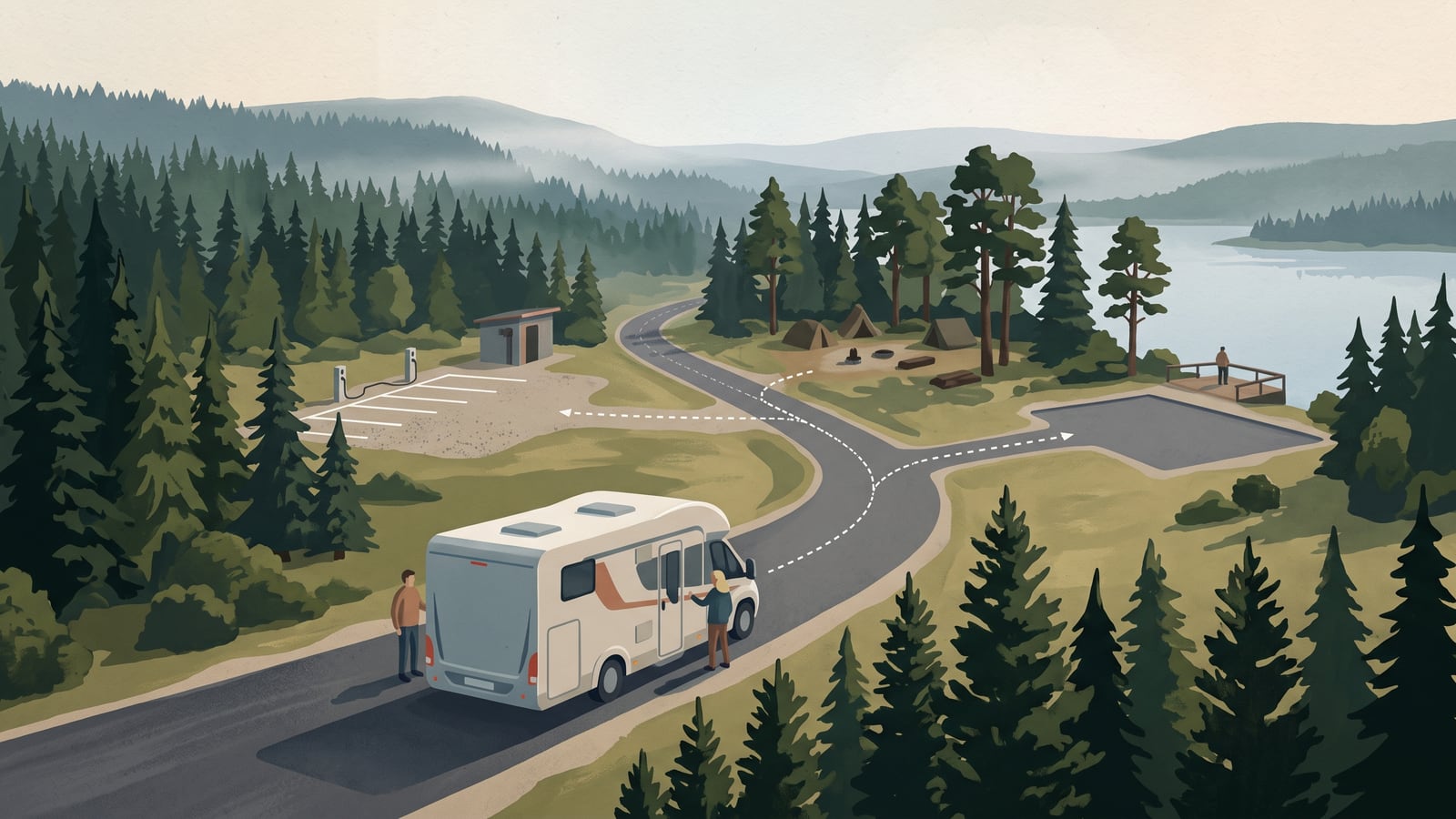
Start with whichever term points you toward tonight's main need. Want the stay terms of a camping establishment? Search "campsite." In France, the full aire wording can point to a particular motorhome-related function within the cited French framework. In Germany, Reisemobilstellplatz is the term worth searching for. A generic "stopover" result, on the other hand, is just a lead worth chasing down.
Every one of these labels has limits. None of them alone tells you whether you can park there, sleep there, or set up camp — or what it costs, what's available, or whether your vehicle fits.
This is a terminology-and-choice guide for first-time European campervan and motorhome tourers. It's not a directory, a legal guide, or a record of stays we've tested. The French and German details below apply only to the national frameworks cited.
The choice at a glance
Use these labels to build a shortlist, then check individual places rather than assuming every member of a category behaves the same way.
| What matters | Campsite | Aire | Stellplatz / Reisemobilstellplatz | Stopover |
|---|---|---|---|---|
| What it points to | A camping establishment and its stay terms | Could mean motorhome parking, a campsite, or a disposal point — check the full wording | A motorhome-oriented overnight candidate in Germany | An unknown place worth investigating |
| Services | Check the establishment's current facilities and whether your pitch includes them | Confirm the exact function, plus any water, electricity, drainage, or disposal provision | German tourism-association (DTV) guidance covers several facility types — check what's there | Assume nothing; find the current operator or authority info |
| What you're allowed to do | Confirm access, parking, overnight use, and permitted behaviour | Check the sign and terms before using space beyond your parked vehicle | Follow the signs and supplementary plates | Find out the real place type before relying on it |
| When it fits | Good starting point if a verified establishment suits your budget, arrival plans, privacy, and the weather | Good option once you know its precise function and current conditions | Good for a motorhome-oriented candidate — check booking and arrival details too | Useful for discovery, weakest for a final decision |
| Vehicle fit | Confirm dimensions, mass, trailer setup, access, and manoeuvring room | Same checks, for the specific spot | Confirm motorhome acceptance — towed caravans need separate confirmation | The label tells you nothing about fit |
Parking, sleeping in the vehicle, and setting up camp are three different questions. Check the current terms before putting out an awning, chairs, or a table. Confirm separately whether you may run a generator, dump waste, or use space beyond your vehicle.
Suitability works the same way. Dimensions, mass, trailer length, turning space, and any accessibility need you have require direct confirmation. A category label — or a generic symbol on a map — can't answer those for you.
Four starting points
Campsite
"Campsite" is the everyday word for a camping establishment. Start here when you want to check an establishment's pitches, stay conditions, and confirmed services as a package.
There's no single service package guaranteed by the word across Europe. Water, electricity, drainage, and waste facilities might matter to you, but their provision and current availability must be confirmed with the individual establishment.
France gives a narrower example. Under its classification framework, a classified campsite can have a separate motorhome parking area, recorded apart from other pitch types. That doesn't mean every campsite has one, or that every listed connection is available there.
A campsite stops being a good candidate once it hasn't confirmed the thing you need — the right function, the behaviour you're planning, or room for your vehicle. Budget matters too: you might prefer to pay for the establishment's bundled services, or arrange water and waste separately elsewhere. The label alone won't settle that comparison for you.
Aire
Aire is French for "area," a broad term with little value on its own. What matters is the full wording on the sign or in the authority's description.
French road-sign rules separate three different things: regulated motorhome parking, a campsite for caravans and motorhomes, and a disposal point. These aren't interchangeable. A disposal point might solve your waste problem without telling you where you're allowed to stay overnight. A parking sign still needs reading in full before you rely on it.
So don't stop at the shortened word "aire." Track down the precise designation, check the current sign and services, and confirm what you're permitted to do there. The word by itself won't tell you about overnight permission, camping rules, availability, or whether your vehicle fits.
Stellplatz or Reisemobilstellplatz
In Germany, Reisemobilstellplatz is the term worth searching if you want a motorhome-oriented overnight spot. You'll also see the shorter word Stellplatz — check the full description rather than relying on that label alone.
Germany's tourism association (DTV) describes several kinds of motorhome place in its guidance for providers. That's useful for orientation, but the guidance isn't binding and sets no minimum standard. A given service level doesn't automatically follow from the name.
DTV also treats motorhomes and car-towed caravans as different cases. Towing a caravan? Confirm the specific place accepts your combination — don't assume a motorhome-focused listing covers you.
If you're travelling by motorhome and just want somewhere to stop before pushing on the next day, this is a sensible term to start with. A campsite can still be the better call when one establishment's verified terms suit your service needs, privacy, weather, or arrival time better.
Stopover
Here, "stopover" is just shorthand for a possible overnight spot. It doesn't promise anything about what that place turns out to be.
That vagueness is helpful when you're sifting through mixed search results — but it also makes "stopover" the weakest term to base a final decision on. Confirm permission, restrictions, and any cost through the current sign or the relevant authority. Facility information and vehicle fit must come from the landowner or operator where applicable.
Use it to start a search. Don't use it to end one.
How the choice changes an evening
Which label matters most depends on what you need that night. These hypothetical situations show how the shortlist shifts — they're not claiming one category is always better.
After a wet driving day
Say you've just finished a long, wet day on the road. You want somewhere predictable for the night, with water and waste facilities.
A campsite is probably the better first search, since you can look for an establishment that confirms exactly the stay and services you need. That still leaves questions: is it open, is there space, does your vehicle fit?
A French aire could work too — but first, get its full designation. Does it describe motorhome parking, camping, or a disposal point? Then check the services on offer and what behaviour is permitted there.
The weather and what you need decide the shortlist. The word on the sign doesn't make the final call.
A simple night in Germany
Now say you're touring Germany in a motorhome and just want somewhere to stop before continuing in the morning.
Reisemobilstellplatz is a good search term, since DTV uses it in exactly this motorhome-oriented context. But DTV's mix of facility types and lack of a minimum standard means you still need to check the individual listing. The word alone doesn't guarantee water, waste facilities, or any particular level of privacy.
A campsite is still worth considering if its current terms suit you better that evening. Price, quiet, ease of access, and equipment depend on the specific place and the day's conditions.
When all you've got is "stopover"
A directory result just says "stopover." Treat that as a lead for further investigation. It isn't a confirmed answer.
Look for the place's actual local name, current authority or operator information, and the signs at the entrance — read every supplementary plate. Parked vehicles already there don't prove your intended stay is allowed, and a directory's silence on the rules doesn't fill that gap either.
Still can't confirm permission and vehicle fit? Use a verified, lawful backup instead.
Verify the actual place
The final call rests on current, place-specific information. In France, official signs distinguish motorhome parking, camping, and disposal points. In Germany, section 39 of the road traffic regulations states that traffic-sign instructions take precedence over general traffic rules, supplementary signs are traffic signs, and the section includes a motorhome symbol. These help you read a sign correctly — they don't grant general overnight permission on their own.
Before you rely on a candidate for the night:
- Read the entrance sign and every supplementary plate when you arrive.
- Check any relevant municipal, protected-area, landowner, or operator terms.
- Confirm you're allowed to access, park, and stay overnight — and that your planned camping behaviour is permitted.
- Check time limits, payment, and any booking conditions.
- Confirm current services, opening times, availability, and restrictions.
- Compare the access with your vehicle's dimensions, mass, and trailer setup — and confirm any personal accessibility need directly.
- Keep a lawful backup ready for anywhere permission, availability, or fit stays unclear.
Pick whichever option best matches tonight's main need. Then verify that one candidate — and one lawful backup — against the list above.
Where to go next
This sits in Camping and overnighting, next to why ordinary parking is not permission to stay the night and how to choose between a serviced site and a simple stopover tonight. For what public-access rights do and don't cover once a vehicle is involved, see Nordic rights of access for campervans and motorhomes, and for whether the place will physically take your vehicle, how size and weight shape a route. The wider Road touring section covers planning, routes, rules and overnighting.
Your next step: name tonight's single most important need, pick the one kind of place most likely to cover it, and check that candidate's current terms and signs before you drive to it.