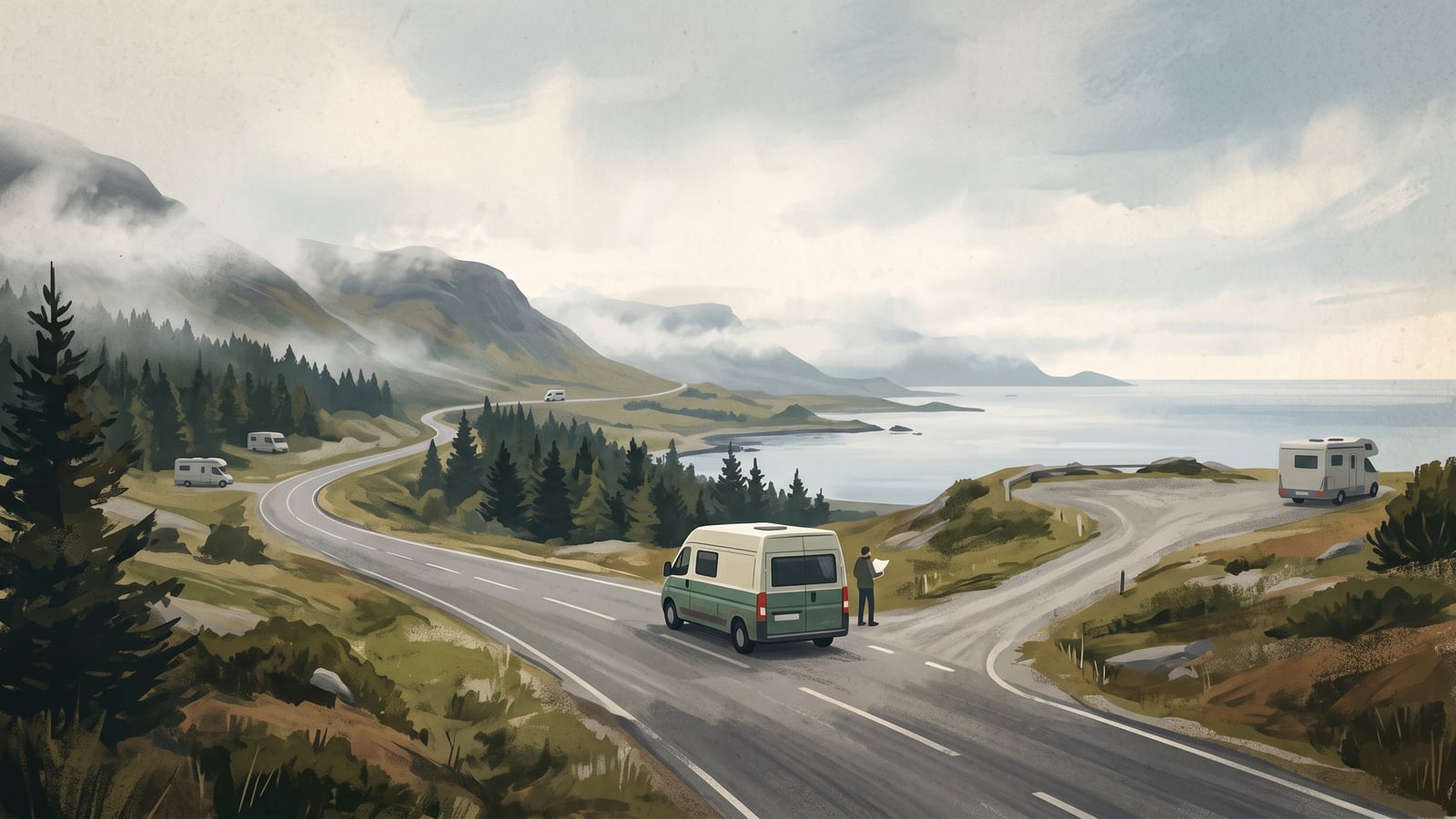
You've probably heard that Finland, Sweden, and Norway let you roam and camp across the countryside. That's real, but incomplete: each country recognises its own form of non-motorised access and qualified tent camping, and the exact governing conditions differ by country. Sweden calls its version Allemansrätten. Norway calls it allemannsretten. Finland calls it everyman's rights. Each gives non-motorised access to open land under its own conditions, and none of them covers motor vehicles. Where you can drive, park, and sleep in a campervan, motorhome, or towed caravan is a separate question. That one gets answered by parking law, off-road driving rules, municipal bylaws, and whoever owns or manages the land you're on.
This guide draws the line between the two. It walks through what Sweden, Norway, and Finland say about vehicles, gives you a five-question method for checking any stop before you commit to it, and includes a record you can fill in on the road.
Sweden: Allemansrätten, rest stops, and private roads
Sweden's right of public access — Allemansrätten — gives you non-motorised access to land that's otherwise open, covering activities like walking, skiing, and cycling. Naturvårdsverket states that this right does not extend to motor vehicles.
Sweden has a separate law for off-road driving, the Terrängkörningslagen. As a general rule it prohibits driving motor vehicles — including campervans, motorhomes, and caravans — onto unpaved natural terrain such as forest floor, beaches, meadows, parkland, or lawns, and a landowner's permission does not override that statutory restriction. In practice, that means the appealing patch of grass beside a lake is off-limits to your vehicle even if nobody's there to stop you and even if whoever owns it says it's fine.
Public rest stops along Swedish main roads are a different matter, because they sit on the road network rather than on natural terrain. As a general rule, motorhomes and caravans can park at these rest stops for up to 24 hours on weekdays, and until the next business day over a weekend or public holiday, unless a supplementary sign or a municipal regulation sets a shorter limit. Check what's posted at the specific stop before relying on that default — a shorter local limit takes precedence over the national one.
Private roads add a third layer. A landowner can put up a sign or a barrier — even a handmade one — banning motor traffic, and that ban is legally separate from the public's non-motorised right to walk or cycle the same route. If a private road receives state maintenance funding (statsbidrag), it generally has to stay open to public motor traffic, though it may be subject to an authorised temporary closure under the conditions attached to that funding — for instance to protect the surface during spring thaw. Check what's posted at the road itself, but treat that as one necessary check rather than the whole answer — the applicable grant conditions and any authorised closure still need confirming where they affect access.
Pulling off the road onto the verge is allowed, but only if you don't damage the ground, block traffic, create a hazard, or interfere with whatever the landowner is doing there. And if you're thinking about parking or placing a caravan or motorhome near someone's house for the night, Naturvårdsverket's own advice is to ask first. For anything more specific than the general rules above, check the destination's own posted terms, the relevant municipal traffic regulations, or ask the landowner directly — national defaults don't cover every local situation.
Norway: Allemannsretten and the motor traffic prohibition
Norway's right to roam — allemannsretten — applies to utmark: roughly, uncultivated outlying land, as opposed to innmark, the cultivated or built-up land around homes and farms. On utmark you can walk, ski, cycle on paths and roads, and camp under the conditions set for tents.
The tent-camping detail people usually quote is this: you can generally stay in one spot for up to 48 hours in lowland utmark (longer in the high mountains or remote areas), as long as your tent is at least 150 metres from the nearest inhabited house or cabin, unless a local municipal bylaw says otherwise.
That 48-hour, 150-metre allowance applies to tents, not to motor vehicles. Norway's Motor Traffic Act sets a general prohibition on motorised traffic in utmark and watercourses, unless a specific statutory exemption or municipal permit applies. It's worth being blunt about this because it's the single easiest mistake to make reading about Norway online: the numbers you remember from the tent-camping rules don't transfer to a campervan or motorhome. A clearing that's a lawful place to pitch a tent isn't automatically a lawful place to park one.
Finland: Everyman's rights and protected areas
Finland's everyman's rights allow walking, skiing, cycling, and temporary tent camping where access is otherwise allowed; driving a motor vehicle off-road sits outside that scope.
Finland adds one more layer worth flagging early: national parks and nature reserves can set their own rules on top of the general framework. These can restrict camping or movement to designated sites or routes within the protected area. If you're heading into a national park or reserve, check that destination's own current rules rather than assuming the general everyman's-rights description covers it.
The five questions to ask before stopping
Once you accept that access rights don't cover your vehicle, the practical question becomes: what does? The honest answer is "it depends on where you are," but the questions you need answered are the same everywhere. Work through them in this order, because each one can rule out a spot before you spend time on the next.
- Is the vehicle allowed on this ground at all? Is it a road, a car park, or a maintained track — or is it unpaved natural terrain that off-road driving law puts out of reach, regardless of how firm it looks?
- Does your vehicle fit here? Check its length, width, height, and mass, plus combined length if you're towing. Compare that against the space available, any posted restrictions, and, if it's a rental, the limits written into your rental agreement.
- What do the parking terms say? Look for posted signs, note whether a general rule like Sweden's rest-stop allowance applies, and confirm there's no municipal rule cutting it shorter.
- Are you allowed to sleep here, or just park here? Some spots permit daytime stopping but not overnight stays; resting inside your vehicle is a different question from camping outside it.
- Are you acting like a parked traveller, or setting up camp? Awnings, outdoor furniture, levelling ramps, and dumping waste are the kind of behaviours whose treatment as parking or as camping depends on the current municipal, land-manager, or operator terms for that specific place.
None of these five questions has a single Nordic-wide answer — each depends on the specific road, land manager, or municipality, so check the applicable local rule rather than assuming one country's general pattern covers another location. A route-planning tool or a stopover app can point you toward a location, but confirming whether it's currently open to you is a separate step — treat the app as a lead you still need to verify.
Two hypothetical situations show how this plays out.
A couple driving a six-metre campervan along Sweden's E4 pulls into a lakeside rest stop at seven in the evening on a Tuesday. The entrance sign is a plain blue "P" with no extra time-limit plate underneath it. That's consistent with the general rest-stop rule allowing up to 24 hours on a weekday, but confirming it would still mean checking whether a municipal regulation for that stretch of road sets a shorter limit. They stay inside the marked bay, keep the awning and chairs packed away, and don't drive down the unpaved track toward the lakeshore grass — that would cross into off-road driving that the parking rule doesn't cover, no matter how quiet the evening looks.
A solo traveller in Norway spots an inviting clearing in the woods, 200 metres off a rural road, and remembers reading that Norway generally allows up to 48 hours of camping in one spot in lowland utmark (longer in remote or mountain areas), at least 150 metres from the nearest inhabited house or cabin, unless local rules say otherwise. That's a tent rule, and it doesn't extend to vehicles. Driving the campervan across the ditch and into the clearing would run straight into the Motor Traffic Act's general ban on motorised travel in utmark. To rest overnight in the vehicle, the traveller needs a lawful parking area or a campsite; to use that clearing at all, it would have to be on foot, with a tent.
Four kinds of stop cover most situations, and they don't carry equal certainty:
- Official public rest stop — Sweden's general 24-hour rule can apply on a weekday, but a posted local sign overrides it.
- Private road or track — check current motor-traffic access, any owner sign or barrier, and applicable grant or closure conditions before assuming it's open; a gate standing open isn't confirmation, and neither is the absence of a sign.
- Off-road natural terrain (forest floor, beach, meadow, lawn) — Sweden's off-road driving law and Norway's Motor Traffic Act generally close this to vehicles, subject to statutory exceptions or specific permissions, regardless of how it looks or who's around.
- Designated campsite or stellplatz — a candidate worth checking directly with the operator, asking them to confirm parking, overnight stays, vehicle fit, and camping-style use for the specific site, rather than assuming those are settled by the category itself.
When the first three raise doubt on any of the five questions, a designated site is worth checking directly — ask the operator to confirm parking, overnight, fit, and behaviour terms for that specific site, rather than assuming any of them is settled by the category alone.
Your overnight-stop record
The Swedish rest-stop figure above is only a general default — check what's actually posted at a specific location before you rely on it. The record below gives you a place to write that check down, along with everything else the five questions ask you to confirm, before you settle in for the night.
OVERNIGHT-STOP RECORD

1. Location & governing authority / land type:
2. Vehicle access confirmed (lawful road vs. unpaved off-road terrain):
3. Vehicle fit confirmed (size, mass, height, trailer combination, and rental-contract limits):
4. Parking terms & time limit verified (posted signs, general rest-stop rule, municipal bylaws):
5. Overnight/sleeping terms confirmed (resting inside vehicle vs. daytime-only parking):
6. Camping-style behaviour avoided (no awnings, levelling ramps, outdoor furniture, waste release):
7. Protected-area, municipal, or landowner checks completed:
8. Live-condition check (closures, thaw restrictions, barrier status):
9. Lawful backup option identified:
Here's what a filled-in version looks like, using the hypothetical Swedish rest-stop scenario above. This is a hypothetical, not a record of a real stop — every input below is invented, and none of it substitutes for checking the actual place yourself.
OVERNIGHT-STOP RECORD (hypothetical example)

1. Location & governing authority / land type: Public rest stop on a Swedish
   E-road, roadside land managed by the road authority.
2. Vehicle access confirmed: Yes — paved rest-stop bay reached directly from
   the main carriageway; no unpaved track used to reach or leave the bay.
3. Vehicle fit confirmed: Assumed vehicle is 6 m long, 2.3 m wide, 2.9 m
   high, loaded mass 3,200 kg, no trailer, privately owned. The marked bay
   is assumed to be at least 8 m long with adequate width for those
   dimensions, but no measured or posted bay dimension was available, so
   fit is provisional until confirmed on arrival.
4. Parking terms & time limit verified: Standard blue "P" sign only, no
   supplementary time-limit plate observed; the general 24-hour weekday
   rule would apply to a Tuesday 19:00 arrival, but current municipal
   traffic regulations for this stretch were not checked in this
   hypothetical, so the 24-hour figure remains unconfirmed rather than
   relied on outright.
5. Overnight/sleeping terms confirmed: Not established from signage alone —
   the absence of a prohibition sign doesn't confirm that sleeping here is
   permitted.
6. Camping-style behaviour avoided: Awning and chairs kept stowed; no
   levelling ramps deployed; no waste discharged at the site.
7. Protected-area, municipal, or landowner checks completed: Rest stop
   sits on the general road network; the municipal check for this
   specific location remains outstanding in this hypothetical.
8. Live-condition check: No closures or barrier observed at time of arrival.
9. Lawful backup option identified: A campsite listing found on a map
   needs confirming before it counts as a backup — its current opening,
   availability, and fit for a 6 m vehicle still need checking with the
   operator.
With items 3, 4, and 5 unresolved, the conservative decision here is not to treat the rest stop as confirmed for an overnight stay. In this hypothetical, the traveller calls the number on the campsite listing; assume the campsite operator confirms that the site can be reached and entered by the declared vehicle, that it has an overnight pitch fitting a vehicle 6 m long, 2.3 m wide, 2.9 m high, with a loaded mass of 3,200 kg, no trailer, privately owned, and that it can take a same-night arrival. That resolves item 9 to a confirmed backup, so the bounded decision becomes: try the rest stop only once the bay's actual dimensions are confirmed to fit the vehicle, the municipal check clears, and the rest stop's own overnight signage allows it, and move to the confirmed campsite if any of those three don't clear by the time it's time to settle for the night.
The takeaway from this hypothetical: a general rule marks where the check starts for a specific stop; what's actually posted or confirmed locally settles it.
Where to go next
This article lives in the camping and overnighting hub. From there, why parking and camping aren't the same thing goes deeper on the distinction this guide relies on, and once the general rules above apply, choosing a roadside rest area in Sweden or Norway and handling water, waste, noise, and fire responsibly cover what happens once you've found a lawful place to stop. The wider road touring section covers trip planning, vehicle prep, and cross-border rules beyond overnighting.
Your next step: pull out your vehicle's registration document — or your rental agreement, if you don't own the vehicle — and write down its exact height, length, and gross mass, plus any clause restricting driving on unpaved or private roads. You'll need that number handy for question two of the five, every time you're sizing up whether a stop fits.