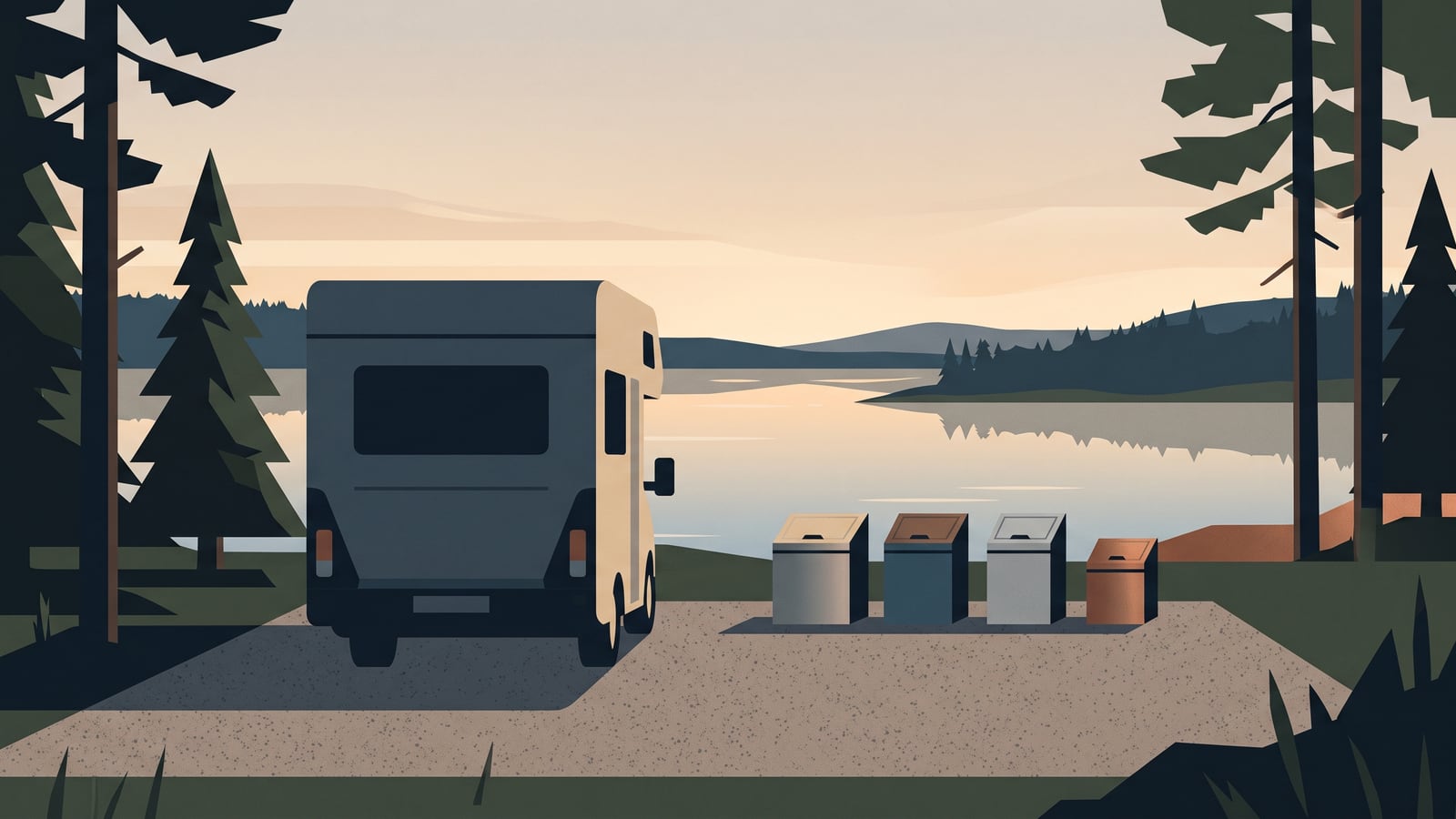
You've found a place to stop for the night. The vehicle's allowed to be there. That's the easy part.
Whether you can put chairs on the grass, empty a toilet cassette, run a generator, or light a stove is a separate question, and it doesn't follow automatically from being allowed to park. This guide walks through that question for campervans and motorhomes with their own fresh-water, grey-water, and toilet systems on board. A caravan with the same onboard systems can use the same checks; a car or motorcycle tourer without a water or waste system can skip those specific rows and still use the access, noise, and fire checks that apply to any vehicle. It covers where parking ends and camping begins, and how to handle fresh water, grey water, toilet waste, and rubbish. It also covers what noise a shared stop can tolerate, and when a fire or stove is legal to light at all. One rule runs through everything below: local signs, site operator terms, and live fire warnings always beat anything general said here. Keep that in mind rather than expecting it repeated at every turn.
Access rights versus parking and camping
Several Nordic and European countries give the public strong rights to be outdoors: to walk, cycle, or paddle on land they don't own, and in some places to pitch a tent. Sweden's allemansrätten and the Scottish Outdoor Access Code are two well-known examples. It's tempting to assume these rights stretch to cover a campervan or motorhome. They don't.
These access rights protect non-motorised recreation on foot, bike, or kayak — they do not include motor vehicles, so parking or overnighting in a vehicle remains a separate question governed by traffic law, municipal bylaws, and whatever the landowner or site operator permits. In Sweden specifically, driving or parking off a proper road onto natural terrain isn't allowed, and a highway rest area generally caps a stay at 24 hours on weekdays unless a sign says otherwise. Scotland's access code is built around people on foot and their tents. It treats camping behaviour — pitching, cooking fires, gathering firewood — as a separate matter from the right to walk across land.
The second boundary is about footprint, not location, though exactly where the line falls depends on the jurisdiction. A vehicle that's simply parked stays inside its own outline: wheels on the ground, doors closed, nothing extended outward. Put down an awning, set out a table, or lower levelling jacks onto the verge, and you may have crossed from parking into what local rules treat as camping. That's worth checking rather than assuming either way.
Spain has written a version of this distinction into national instruction — a useful illustration, even though it applies only there. Under Spain's DGT Instruction PROT 2026/04, a vehicle counts as legally parked, not camping, only while it stays within its own closed perimeter, touches the ground through its tyres — plus any chocks required by traffic regulation — and puts out no awnings, tables, or other exterior items, fluids, or noise; regional and municipal rules in Spain can still add further restrictions on top of that. The underlying idea — closed footprint, no discharge, no external gear, no noise — is a reasonable starting checklist anywhere. Whether it's the actual legal test where you are is something only the local rules can confirm.
None of this makes overnighting in a vehicle impossible, or always a grey area. It means the parking permission and the camping permission are two separate checks, and you need to run both before you settle in.
The pre-settling decision check
Before anything comes off the vehicle or out of a tank, run through this. It's a planning and arrival aid: the sign at the stop, the operator's terms, and any live wildfire warning govern what actually applies on the day, and this check can't certify current legality, availability, vehicle-system compatibility, or safe fire conditions on its own.
| # | Check | If confirmed | If unclear or no |
|---|---|---|---|
| 1 | Access & stay authorisation — are motor vehicles allowed to stay overnight here? | Proceed to check 2 | Do not stay; find another stop |
| 2 | External footprint — does the stop allow awnings, furniture, and chocks outside the vehicle, or closed-vehicle parking only? | Set up within what's confirmed | Keep the footprint closed |
| 3 | Fresh water — is the tap confirmed as potable and meant for filling leisure tanks? | Fill as normal | Don't fill from it; use what's already on board or find another source |
| 4 | Grey water — is there a signed, working drain for it here? | Use the designated drain | Retain it on board |
| 5 | Toilet waste — is there a separate designated chemical disposal point for the cassette? | Use that point | Keep the cassette sealed and retain it |
| 6 | Rubbish & recycling — are bins provided for visitors, or must you pack waste out? | Use the bins as marked | Pack everything out |
| 7 | Noise & generators — are quiet hours in force? Are generators or engine idling restricted? | Operate within stated hours/limits | Don't run a generator or idle the engine unless current posted or operator terms confirm it's allowed |
| 8 | Fire & cooking — is your chosen appliance permitted, is there no active wildfire warning or local ban, and is the ground suitable? | Light only once permission, appliance type, and conditions all clear | Don't light anything outdoors; use only a separately confirmed, compatible alternative, or eat cold food |
The rule behind every row is the same: if you can't confirm permission or a facility exists, treat it as not allowed rather than a grey area to interpret generously. The fire and cooking section below sets out exactly what that check involves.
Here's how that plays out in practice. Picture a campervan pulling into a rural rest area for the night, with a couple hoping to empty the chemical toilet cassette and cook dinner on a portable twig stove. Working through the check: overnight parking is fine at this stop, but — in this scenario — there's no black-water disposal point anywhere on site, and the regional fire authority has an active wildfire warning in force. Both the toilet-waste and fire checks come back "no." So the cassette stays sealed, the twig stove stays packed away, dinner gets cooked on the vehicle's own enclosed gas stove instead, and the plan for the morning becomes a short drive to a nearby campsite that — in this illustration — can take both the cassette and a water refill. The evening isn't wasted. The containment decision just moves the servicing to the next stop that can support it.
Choosing an overnight stop type
Different stops are built for different parts of this job. What a specific stop offers still needs confirming on arrival or in advance, but knowing what to look for tells you which type is worth heading toward.
A fully serviced commercial campsite is the candidate when you need a complete reset: fresh water, grey- and black-tank emptying, and power, plus outdoor living within whatever the site's own rules on fires and quiet hours allow. Confirm current opening times, arrival process, and pricing directly with the site rather than assuming any of it. It's the wrong choice if you're arriving late for a quick transit stop, or want to avoid other travellers entirely.
A dedicated motorhome stopover — a Stellplatz or aire — sits between a campsite and plain parking. Confirm at the specific stopover which waste streams it accepts, whether exterior setup such as awnings or furniture is permitted, and what the current municipal or operator terms allow — none of that follows from the category alone.
A lawful general parking area or roadside rest stop works for a short, low-impact sleep during a longer drive, where the local rules explicitly permit overnight parking. Confirm the current time limit and whether any exterior setup is allowed at that specific place — Sweden's standard rest-area allowance is a useful benchmark at 24 hours on weekdays unless a sign says otherwise, but that figure is Swedish, not universal. It's a poor fit if your tanks or cassette are close to full and the exact place has no confirmed disposal facility, or if what you want that evening is to sit outside and cook.
Which one to head for on a given night comes down to what your vehicle needs serviced and what you want from the evening: a rest area for a simple sleep with tanks that have room, a stopover when you need to empty something and keep moving, a campsite when you want everything reset at once or an evening outside.
Managing water, sanitation, and rubbish
Treat fresh water, grey water, toilet waste, and rubbish as separate streams. Keep them separate, and confirm the designated disposal point before using it rather than guessing.
Fresh water only goes into a leisure tank from a point confirmed as meant for it — a marked tap at a service point, campsite, or stopover, once you've checked it. A tap with no signage, or a hose left by a previous visitor, isn't something to assume about. If you can't confirm it, don't fill from it.
Grey water from sinks and showers, and the contents of a chemical toilet cassette, should go only into a point that's clearly signed and built for that purpose — never into a ditch, a storm drain, or onto open ground. If no such point exists at a stop, the waste stays in the tank or cassette until you reach one that has it.
Rubbish gets the same discipline. Use bins if they're provided and marked for visitor use; if they're not, or you're not sure, pack everything out with you. In Sweden, current guidance also specifically warns against leaving pork or cured-meat scraps in the open, because of the disease risk they carry for wild boar and pigs — a reminder that food waste isn't harmless just because it's biodegradable, and worth applying more broadly even where it isn't spelled out by name.
Don't assume a service point is free, either. Some campsites and stopovers charge a fee or require a token for water, power, or waste disposal, so check that alongside the facility itself rather than after you've used it.
Noise, generators, and footprint courtesy
A shared overnight stop — a campsite, a stopover, or a lay-by with two other vehicles in it — works better when everyone keeps their footprint and their noise modest. That's not a legal category in the same way parking-versus-camping is, but it shapes whether you're welcome back, and whether the next arrival has a workable spot.
Practically, that means keeping music, conversation, and vehicle doors quiet once other travellers have settled in, and treating any posted quiet hours as the outer limit rather than the target. Generator, idling, and quiet-hour terms are place-specific. Check the current posted or operator rules, and default to running as little as possible after dark regardless of what's posted.
None of this needs a special routine. Keep the vehicle's outline tight where the site expects that, keep noise low after dark, and check before running anything that generates sound or exhaust through the night.
Outdoor fires, stoves, and wildfire restrictions
Having outdoor access, or even a fire pit built into a stop, doesn't by itself make a fire legal. Before lighting anything outdoors — grill, twig stove, or open fire — check the current official wildfire warning or municipal fire ban for the area and confirm the landowner's or site operator's permission, since neither a fire pit's presence nor a previous visit proves either one. Exactly how each element of that check gets established — who grants permission, how an appliance is classified, which authority issues a warning — depends on the jurisdiction; treat this as the shape of the check rather than a single law that applies everywhere.
Appliance classification catches a lot of travellers out. Under Finnish rescue law, disposable barbecue grills and portable twig stoves are classified as open fires, not as separate, lower-risk cooking equipment, so they are barred during any declared wildfire warning just like a fire laid directly on the ground. A stone ring around the fire doesn't change that classification. Don't light a disposable grill or twig stove unless applicable landowner or designated authorisation is confirmed and no wildfire warning or additional prohibition is active.
Ground matters as much as appliance, and the detail differs by country. In Sweden, fires shouldn't be lit on peat or moss, which can smoulder underground long after the visible flame is out, or on bare rock slabs, which crack under heat. A municipal fire ban there can prohibit a fire even at a spot with a built hearth, so a permanent-looking fire ring isn't proof that fires are currently allowed. Scottish guidance carries a similar caution in different terms: avoid lighting fires during dry spells or near peaty ground and forestry, and don't strip standing or fallen deadwood from the habitat to fuel one.
Take a hypothetical case: a family touring Finland in a motorhome, with a full toilet cassette, hoping to light a portable twig stove for dinner near an unserviced forestry parking area. In this scenario, checking the current Finnish wildfire warning turns up an active one for the region. That puts the twig stove out of use immediately — it's classified as an open fire, and warnings bar open fires outright, regardless of how the stove is built. The parking area's toilet, in this illustration, is a plain dry toilet not fitted for chemical cassette disposal, so that need goes unmet too. Rather than lighting the stove anyway or emptying the cassette somewhere improvised, the family — in this hypothetical — drives on to a nearby campsite confirmed to have a cassette-emptying point and an indoor kitchen they can use instead. The twig stove stays packed away for as long as the wildfire warning is in force, since that classification applies wherever they go, not just at this particular parking area.
Where to go next
This guide sits in the camping-and-overnighting hub, alongside guides that help with the decisions that come before and after this one. If you're still working out what kind of overnight stop fits your route, campsites, aires, Stellplätze and stopovers explained lays out how those categories differ. If you want more detail on the legal line between parking and camping specifically, see parking versus camping: why the distinction matters. For the day-to-day rhythm of arriving, settling, and leaving a stop with consideration for other travellers, sleep, privacy and manners at overnight stops picks up where this one leaves off. And if your vehicle's own water and waste systems need attention before you're even thinking about a specific stop, safe water and waste hygiene in a touring vehicle covers that ground. All of these sit within the wider road touring section.
Your next step: check your vehicle's current fresh-water, grey-water, and toilet-cassette levels. That number tells you whether confirmed servicing capacity is one thing you still need at your next stop; the fuller check above — access, facilities, noise, and fire together — decides where that stop should be.