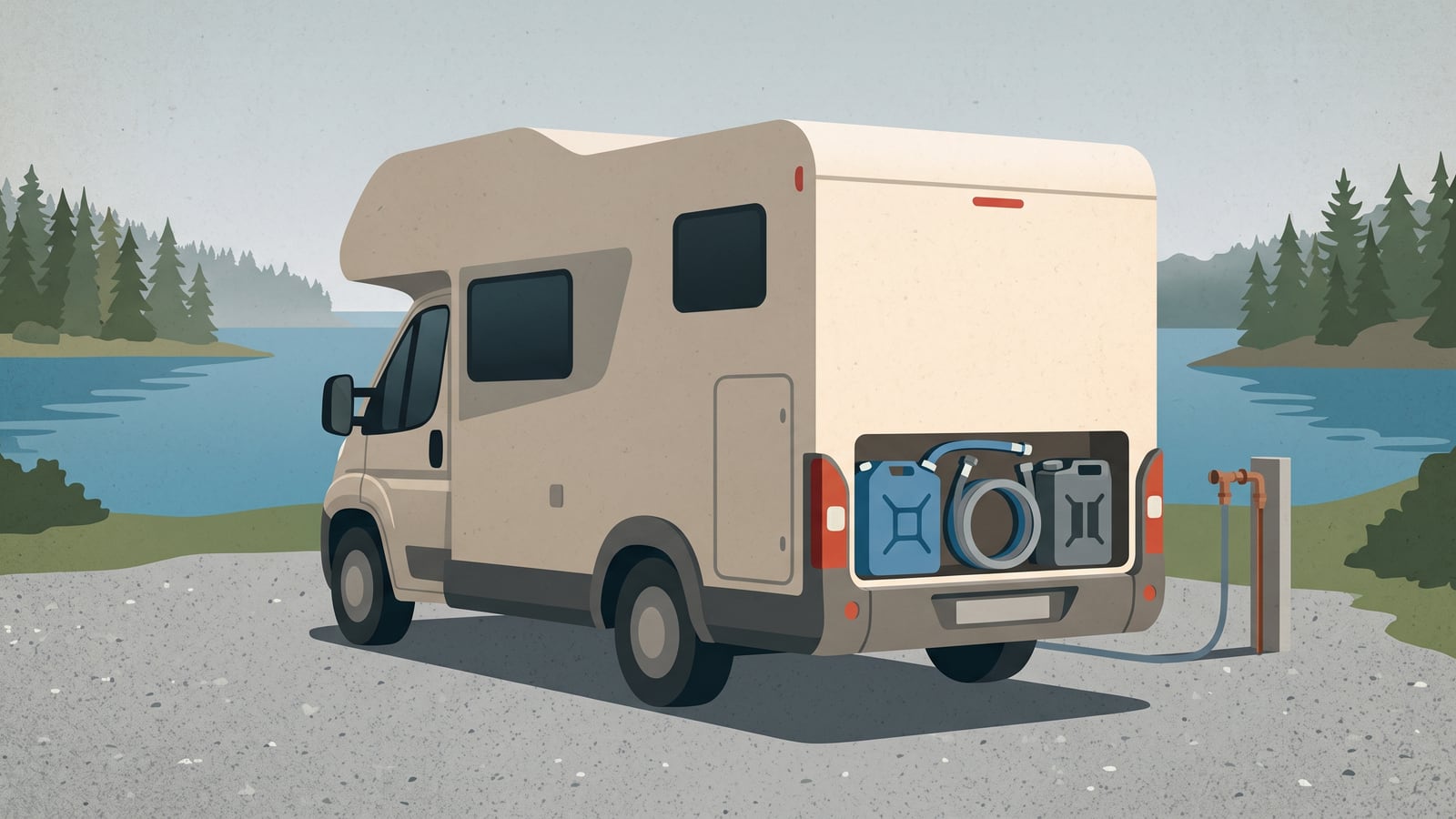
Faecal contamination is one of the biggest risks to drinking water, and it doesn't take a leaking tank to spread it. A hand that's touched toilet waste, a hose that brushed a dump-point surface, or a container previously used for waste, lower-quality water, or another incompatible liquid can all carry contamination into a drink or onto equipment that later touches your water. None of this means your vehicle's tank, hose, or container is contaminated. It means the two jobs — supplying drinking water and clearing waste — need to stay apart, on purpose, every time.
This is for first-time campervan and motorhome travellers handling these systems in an unfamiliar vehicle, whether it's a new purchase or a rental. What follows is a compact, system-neutral routine, not a technical manual. The exact layout of your water and waste systems, the current status of a water source, and the rules at a given disposal point are things you confirm at the point of use: your vehicle's manual, the rental handover, and whichever operator or authority applies have the final word.
Keep the workflows apart
The idea behind everything below is simple: potable water needs its own dedicated, protected workflow, and you cut off any point where waste handling could touch it. Potable water means water you intend to drink and have currently confirmed as safe to drink — looking clean or resembling a tap you've used before doesn't count. Waste handling covers grey water and toilet waste alike.
The equipment used for drinking water — a fill hose, a jug, a storage container — should be used only for that job and kept away from waste hoses, waste containers, and dump-point surfaces. Hands are the part that moves between both jobs, so wash them after any waste contact and before you touch potable equipment again — that closes the loop. Think of it like running two small kitchens in the same vehicle: nothing wrong with either one, as long as the utensils never cross over.
Three different streams
It helps to know what you're handling before you decide what to do with it.
- Potable water is water intended and currently confirmed for drinking. Health-authority guidance on safely managed drinking water describes freedom from faecal and priority chemical contamination. That's a description of what safe water looks like. It isn't a test you can run on a particular tap or vehicle supply. A tap looking clean, or having worked fine for someone else last season, doesn't establish that it's safe now.
- Grey water is wastewater from washing, showers, or the kitchen sink. This distinction is illustrated by planning guidance we inspected from Wales, though exact definitions can vary between places and facilities.
- Toilet waste is a separate stream containing material from the toilet system. Don't assume grey water and toilet waste can go to the same disposal point — whether either one is accepted depends on the specific facility and the rules that apply there, which the checklist below covers.
Hands and equipment connect them
Picture an ordinary stop: you empty the toilet cassette, then walk straight to the tap to top up the water tank. That's the exact moment separation can fail. Contamination on hands, a container, a connector, or a waste tool can transfer onto potable equipment through simple contact — general hygiene guidance is clear that hands carry contamination to drinks and objects this way.
As a cautious cross-contact control drawn from that general guidance, wash your hands after waste contact and before you touch potable equipment again. It isn't a tested protocol built specifically for motorhome plumbing, and it won't guarantee sterile equipment — it's a habit that closes the most obvious gap.
It also helps to keep your potable containers, hose, and connectors visibly different from your waste kit — a different colour, say, or a container you never use for anything else. That's editorial good practice, not a rule that every vehicle or every piece of equipment must follow; it just makes the mistake harder to make by accident.
The five-stage routine
This routine cuts down avoidable cross-contact. It doesn't certify that any given water is safe to drink, that a disposal is lawful, or that your vehicle's system is in good condition — those depend on checking with the right source each time.
- Before filling. Work out the exact system in your vehicle — check the manual or your rental handover if you're not sure. Confirm the source you're about to use is currently designated or verified as potable; don't rely on appearance or the fact that it's labelled for another vehicle's use. Only bring out equipment that has a dedicated potable-water role.
- While filling and using water. Keep your potable connectors and containers away from hands, surfaces, containers, or tools involved in waste handling. If you've had any waste contact in between, wash your hands before going back to the potable equipment.
- Before disposal. Identify whether what you're carrying is grey water or toilet waste — they are not interchangeable. Confirm the receiving point is open, authorised, and currently accepts that specific stream. Do this by checking with the receiving-facility operator and, where relevant, the municipal or environmental authority that governs that stream — a sign alone might not tell you enough. Then follow whatever instructions the operator gives you.
- Stop and verify. Pause if:
- the source's status is unclear
- facility instructions are missing or contradictory
- you suspect cross-contact between potable and waste equipment
- something looks or smells wrong
- there's leakage or cracking
- a container's history is uncertain
- you're not sure the waste is properly contained
- Ask the right source. For potability, that's the water authority or the source's operator. For disposal, it's the receiving-facility operator and, where relevant, the municipal or environmental authority. For anything about your vehicle's system condition or treatment — as above, that's your manual, rental provider, or a qualified service.
When to stop
Don't use water when you can't currently establish that it's safe to drink, or when a warning applies. Don't dispose of waste when permission, acceptance, or instructions are absent or contradictory. Stop the transfer if you doubt the containment or the equipment's integrity — a cracked container or a hose you're unsure about is reason enough to pause.
This article sticks to planning and verification. It leaves out the technical side — chemical dosing and disinfection recipes; treatment settings and flushing sequences; plumbing work, repairs, and opening a pressurised system; and product compatibility. Those depend entirely on the specific system you have, and only your exact manufacturer manual, rental provider, or a qualified service can tell you what's right for it.
If you're dealing with a significant spill, exposure, or an immediate hazard beyond routine handling, move away as appropriate and follow the direction of the relevant local public-health, environmental, or emergency authority rather than trying to manage it yourself.
Three everyday decisions
These are hypothetical situations meant to show the routine in action. They're not field reports, and they don't claim any particular facility exists or behaves this way.
The unmarked tap
You pull up at an unfamiliar service point. There's a tap, but nothing tells you whether it's meant for drinking. It would be easy to fill up anyway — the tap looks the same as ones you've used before, and it's right there. But appearance and proximity don't establish potability. The sensible move is to pause, check current information from the site operator or the local water authority, and if you can't confirm it, use another source that's currently confirmed as potable by its operator or the local water authority. Filling from an unverified tap just because it's convenient is exactly the shortcut this routine exists to prevent.
The uncertain hose
Later in the trip, you notice your potable fill hose was coiled up next to the waste-hose kit after the last stop — or maybe a drinking-water container has a hairline crack and you can't remember how long it's been there. Either way, the right response is the same: take that item out of use and don't reach for a cleaning method or a repair you've read about online. Consult the exact instructions for your system, your rental provider, or a qualified service. If you've got a separate, dedicated potable setup that's unaffected and confirmed fine by those same sources, use that instead. Otherwise, pause potable use until you can confirm it.
The unclear dump point
You find a disposal point, but the signage or instructions don't make clear whether it takes your vehicle's specific waste stream — say, it looks set up for grey water but you're carrying toilet waste too. Don't assume a listed facility accepts everything. Work out which stream you're holding, keep it contained, and check with both the point's operator and the appropriate local authority before you commit. If acceptance can't be established, look for another point that's currently authorised for that stream instead.
Before you fill or dump next
Before your next fill or disposal, work out the exact system in your vehicle and where the waste is going. Check the current manufacturer manual or your rental instructions rather than assuming your last vehicle worked the same way. Find out who currently confirms the water source is potable, and who currently confirms the receiving point accepts your waste stream. If the exact system or its applicable manual or rental instructions, current potable-source confirmation, or current receiving-point acceptance is missing, pause the relevant operation. Filling, dumping, cleaning, dosing, or repairing by guesswork is exactly the shortcut this routine is built to rule out.
Where to go next
This sits in Vehicles and equipment, next to the vehicle’s other onboard system. For the daily habits that use it, see the food, water and washing routine, and for what the land permits, what Nordic rights of access do and do not allow. The wider Road touring section covers planning, routes, rules and overnighting.
Your next step: go and look at the actual inlets and outlets on your own vehicle — which one takes potable water, which one releases grey water, and where the toilet cassette empties — and confirm each against the manual before you use any of them. A vehicle you haven't had long is exactly where these get mixed up.