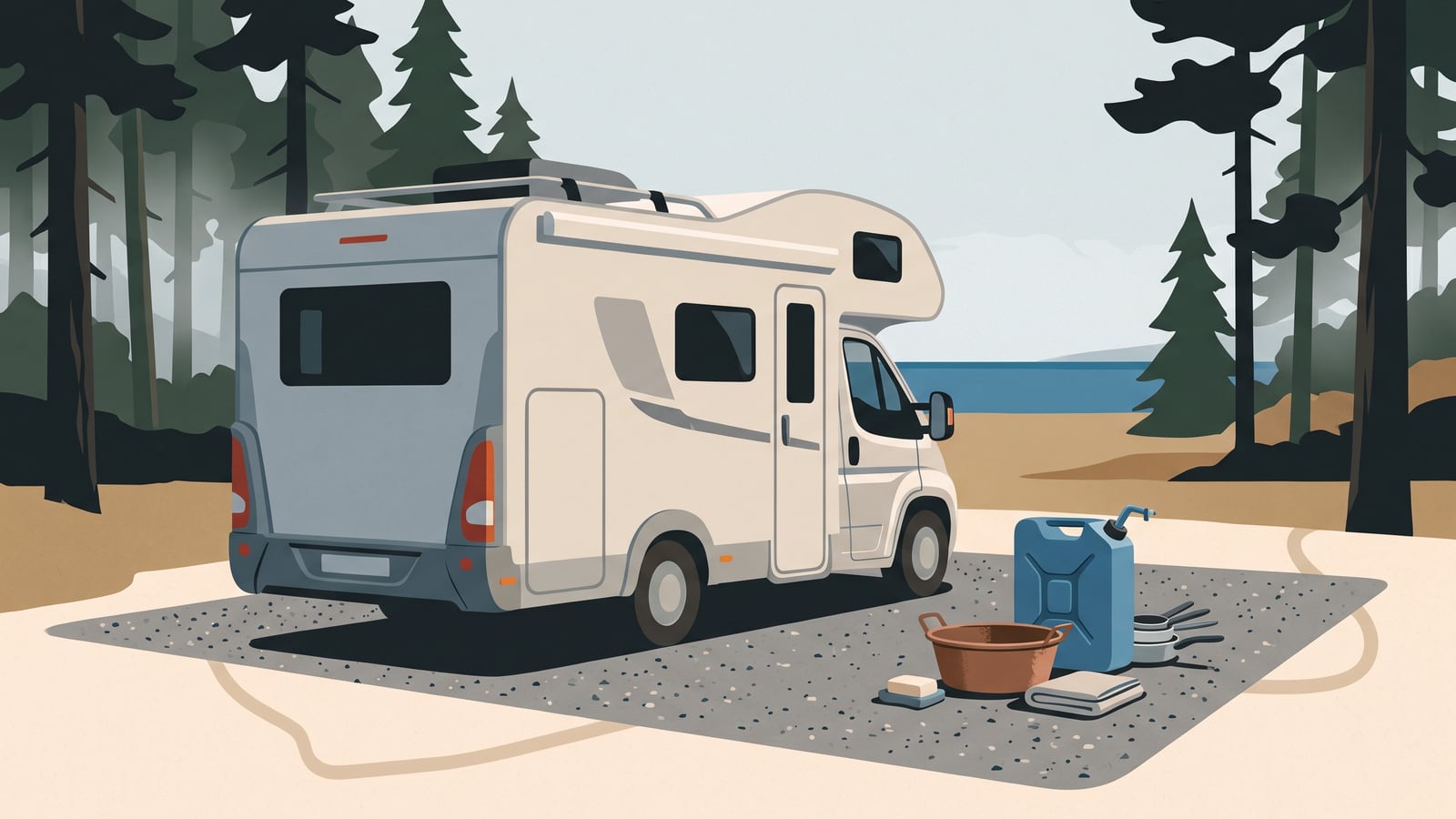
Keeping your food and hands clean is one decision. Where that water goes once you've washed up or had a quick wash is a different one — and doing the first well doesn't answer the second. On the road, especially if you're in a campervan or motorhome for the first time, it helps to treat these as two separate questions with two separate answers: durable hygiene habits for food, hands and drinking water, and current local instructions for anything you release outdoors.
Think of this as a portable daily routine for food, hands and drinking water. It won't service your onboard tank, plumb a grey-water outlet, manage a toilet cassette, do your laundry, or walk you through your specific campsite's rulebook. And it can't confirm that any particular tap, well or nature site near you is safe to use or open for washing — only you, checking on the day, can do that. What it can do: keep your food and hands genuinely clean, protect your portable water supply from contamination, and flag the exact point where you need a local permission check instead of an assumption.
Your daily hygiene loop
This is ordinary adult community hygiene, adapted for a portable water container and a moving trip. It doesn't cover situation-specific medical, accessibility, child or animal needs — if any of those apply to you, get advice suited to that situation before relying on this routine alone.
- Confirm the water. Before you fill a drinking-water container, verify that the actual source is potable. A clean-looking tap, a map pin, or another traveller's word isn't enough. If you're not sure the source is safe, or not sure any treatment you're considering actually works, use an alternative source known to be safe, or ask the actual water provider, the local health authority, or check the relevant manufacturer instructions for anything you're treating water with.
- Protect stored drinking water. Keep drinking water in a clean, protected container dedicated to that purpose, made of food- or drinking-water-contact material and fitted with a secure cover. Keep its tap or withdrawal utensil clean.
- Handle food carefully. Wash hands, surfaces and equipment before you start. Keep raw meat, poultry and seafood separate from other food. Cook food thoroughly, use safe water in preparation, and wash fruit and vegetables. Refrigerate cooked and perishable food promptly, preferably below 5 °C, and keep hot-held cooked food above 60 °C before serving. Do not use food beyond its expiry date.
- Wash hands at the moments that matter. Before preparing food, before eating or feeding someone else, after using the toilet or handling faeces, after coughing, sneezing or blowing your nose, and whenever your hands are visibly dirty.
- Plan the washing before you start it. Before washing dishes or yourself, work out where the water is allowed to go. At Metsähallitus nature destinations in Finland, keep washing and dishwater out of natural waters and off well covers; let it soak into the ground away from natural waters and water-supply points. No universal distance is stated.
- Keep the outputs separate. Ordinary rubbish, portable wash water, your vehicle's grey water, and toilet waste are four different things with four different answers. At Metsähallitus destinations, take ordinary rubbish away with you, since bins or recycling points may be absent. Grey-water systems and toilet waste sit outside this routine and need their own guidance.
- Stop when permission isn't clear. If you can't find current instructions on outdoor disposal, or they contradict each other, hold onto the wash water rather than guessing. Check with the destination land manager, the municipality, or the campsite or facility operator, as applies to where you are, and confirm acceptance before relying on a facility — that it exists, is open, and takes that kind of waste.
Food and hands
The steps above aren't arbitrary — each one closes off a specific way contamination gets in. Dirty hands or equipment carry it onto food you're about to eat. Letting raw meat, poultry or seafood touch other food carries it across. Undercooking leaves it alive. Poor temperature control lets it multiply. And food past its expiry date reintroduces a risk the earlier steps were supposed to prevent.
Hold onto the temperature figures exactly as given: refrigerate promptly, preferably below 5 °C, and keep hot-held food above 60 °C before serving. These aren't a fridge setting to punch into your van's thermostat and forget. They're qualified public-health guidance, and they don't make food with an uncertain history safe just because it passed through the right range at some point.
Hand hygiene works the same way — it closes specific gaps rather than following a general "wash often" rule. The moments that matter are listed in the checklist above. This routine tells you when to wash your hands. It doesn't specify technique, duration or product.
Two water decisions
It's easy to treat "is my water clean" as one question, but it's really two, and they don't answer each other. The first is whether the source is potable in the first place — a decision about the tap, well or supply point itself. The second is whether you keep it clean afterward, through collection, transport, storage and pouring. A source can be genuinely safe and still get contaminated by a dirty container, tap or withdrawal utensil. Equally, the cleanest container in the world does not verify the source as potable — it just stops you undoing a decision someone else already made correctly.
That's why the checklist splits the two. Confirming the source is step one, and it stays a live check every time you're at a new supply — appearance and other travellers' say-so don't settle it. Protecting a portable drinking-water container is step two: clean, covered, made of food- or drinking-water-contact material, with a clean withdrawal point. This is a cautious extension of household water-storage guidance to a portable container; it is not tank servicing guidance, and it says nothing about how your vehicle's built-in system should be filled, cleaned or maintained.
When you genuinely don't know whether a source is safe, or you're not confident a treatment step will work, don't experiment — fall back to the alternative-source and verification options in the checklist above.
Washing depends on place
Once you've decided to wash dishes or yourself, the hygiene part of the decision is mostly done. What's left is a place question: where's that water allowed to go here? A hygiene routine can't answer that on its own — it depends on the land, the water nearby, and whoever manages the site.
The clearest evidence available is Metsähallitus guidance for its nature destinations in Finland, given in full in the checklist above. It's worth being clear about what that guidance covers. It's one land manager's rule for a specific kind of site. It doesn't automatically carry over to a different country, a different Finnish destination type, or a private campsite, and it isn't a Finnish law or Nordic standard. And since no universal distance is stated, don't treat any particular number as safe everywhere — that's precision the guidance doesn't offer.
It's also worth being clear about biodegradable products here. A biodegradable label does not establish local permission on its own — the land manager's current instruction, or the operator's rules, still decide that.
Rubbish follows similar logic, though it's simpler. At Metsähallitus destinations you're expected to pack out ordinary rubbish yourself, since bins or recycling points may be absent there. That instruction covers ordinary visitor rubbish at those specific sites — it says nothing about toilet waste, and it doesn't tell you whether a particular bin exists at a place you haven't checked yet.
One ordinary touring day
This is a hypothetical day — meant to walk through the sequence, not to describe a trip that took place.
Picture a first-time motorhome traveller starting their morning. Before filling the portable drinking-water container, they get the site or supply point to confirm the source is genuinely potable, rather than trusting how it looks. They fill the container, keep it covered, and keep its spout away from dirty hands or surfaces. Breakfast means keeping raw meat, poultry and seafood separate from other food, washing hands before handling anything, and skipping anything past its expiry date.
Later that day they stop at a Metsähallitus nature destination. Before washing the lunch dishes, they check the destination's current instructions rather than assuming yesterday's site rules carry over. Washing water goes onto ground well away from the nearby stream and the site's water point, following the destination's guidance rather than a fixed number worked out in advance. There's no bin at this particular stop, so the rubbish goes back into the van instead of being left behind.
By evening they want a proper wash. But the destination's posted information doesn't say anything about where wash water from a full wash may go, and nothing else at hand resolves it. Rather than guess, they hold onto the water and plan to use an authorised facility once they've confirmed it exists nearby, is open, and takes that kind of waste. None of this should be read as implying that a particular source, bin or facility exists anywhere in particular — it's the sequence that matters, not the specifics of the day.
Make the two live checks
Copy the seven-step loop above and use it daily; it doesn't change much from one day to the next. What does change, every time you move, are two things worth checking before you rely on them.
Before you collect drinking water, identify the actual potable-water provider at that place — the site operator, municipal supply, or whatever's named on-site — rather than assuming the last place's answer still applies. If that provider can't confirm potability, or you're unsure a treatment step will work, fall back to an alternative source known to be safe, or ask the local health authority or check the relevant manufacturer instructions for your treatment method.
Before you produce wash water, identify the relevant destination land manager, municipality, or campsite or facility operator for wherever you're standing, and find their current instructions. If you're planning to rely on a specific facility for disposal, confirm acceptance before relying on it — that it exists, is open, and takes what you're bringing. Those two checks, repeated at each new place, are what turn a sound daily routine into a trip that stays on the right side of both hygiene and permission.
Where to go next
This sits in Life on the road, next to the wider daily rhythm this hygiene loop fits inside. For the vehicle side of the same problem, see how your vehicle’s own water and waste system works, and for what the land itself permits, what Nordic rights of access do and do not allow. The wider Road touring section covers planning, routes, rules and overnighting.
Your next step: before your next fill, name the actual potable-water provider at that place, and before your next wash, name the land manager or operator whose instructions apply. If either is unclear, treat it as a reason to wait rather than to guess.