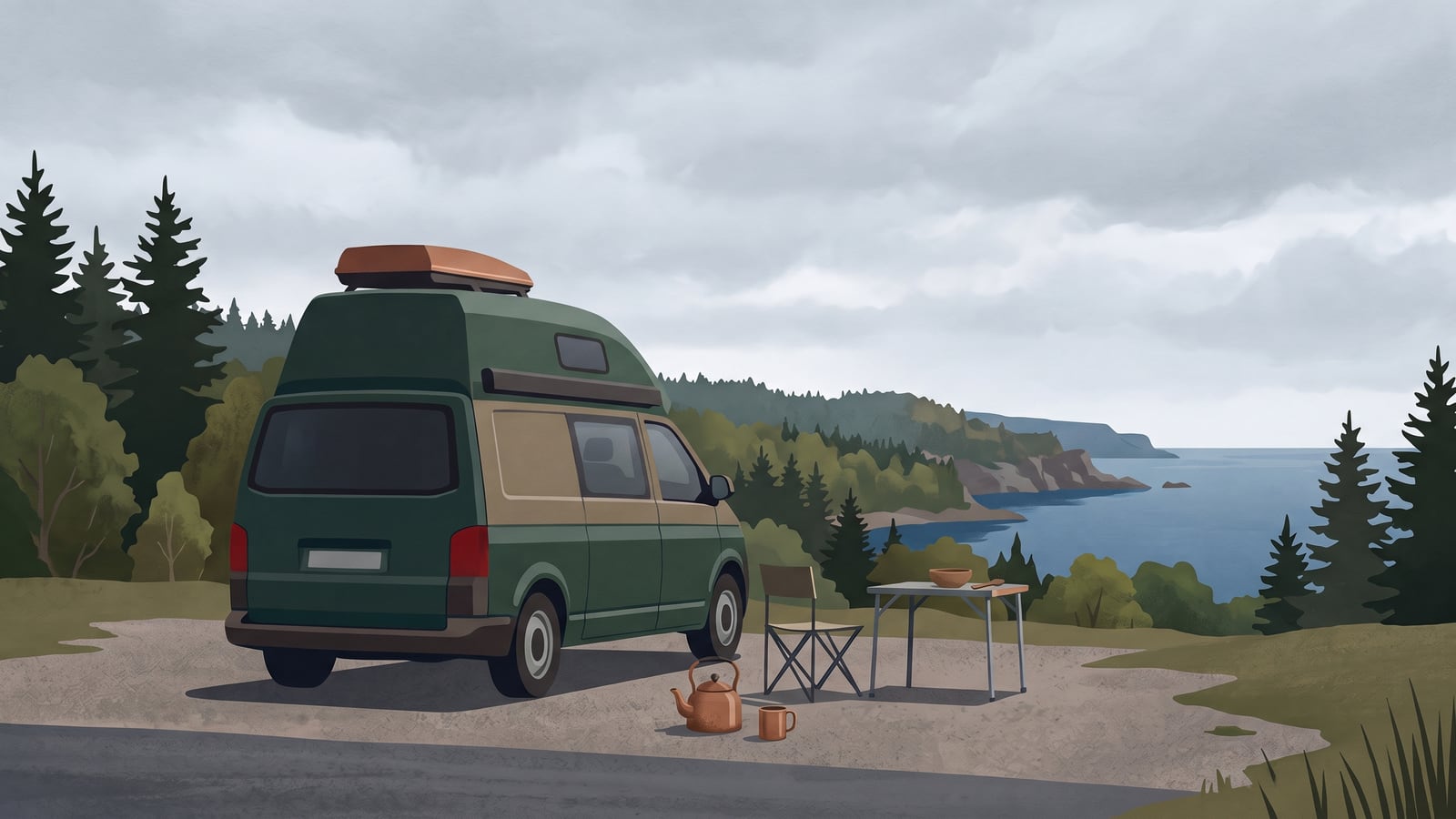
A touring day is a container, not a driving quota. It has to hold meals, a stretch of movement, enough rest to stay sharp, and a place to stop that you're allowed to use. When one of those things goes wrong — a bad night's sleep, a cooler that quietly loses power overnight, a stop that turns out to need a permission you don't have — the plan should bend. That's what this article covers: how to build a flexible daily rhythm for a campervan or motorhome tour through Sweden and its neighbours, with a copyable template and one fully worked day showing what happens when the morning doesn't go to plan.
This is written mainly for campervan and motorhome travellers. Car tourers and people towing a caravan get their own section further down, because a boot full of cool-bags is not quite the same planning problem as a fridge wired into house batteries.
Food that fits the day
You don't need a special touring diet. The same principles that apply at home apply here: eat a reasonably varied mix of foods, don't overdo any one thing, and match what you buy to what's available locally and to your own needs, rather than sticking to a fixed shopping list. Oats, bread and cheese, a pan and a few staples are one illustrative, adaptable combination — what suits you depends on your own diet and what the nearest shop stocks.
Refrigeration is the part that's specific to touring. If refrigeration fails, note when it happened, keep the fridge closed as much as possible, and check temperature rather than judging perishables by sight or smell; treat high-risk items like raw meat, poultry or fish with particular caution, and when you're unsure, follow guidance from a food safety authority — in Sweden, Livsmedelsverket — rather than a fixed rule of thumb. How long food stays usable after that depends on the food itself, the temperature it reached and for how long — there's no single hour figure that covers every case — so treat anything affected as unresolved rather than testing it yourself.
Watch your own food-safety and waste habits the way you would at home, just with less counter space.
Movement and rest as part of driving
Driving is sedentary, hours of it in a row. Building movement into the day isn't about hitting a fitness target — it's about breaking up the sitting. A short walk at a rest stop, stretching while the coffee brews, a longer detour through a forest trail if the terrain and your own fitness suit it: all of these count. What matters is getting upright and moving; the distance or pace doesn't.
Treat this as adaptable rather than scheduled. Some days the stop is a five-minute leg-stretch in a car park. Other days it's an hour on a coastal path because the weather's good and everyone wants it. Match the movement to the traveller and the place you're in that day, rather than a plan made the night before.
Fatigue changes the stage
Fatigue is not a minor discomfort. It can impair your reaction time, steering precision, following-distance control and attention — the things that let you notice and respond to a hazard in time. It builds from a few recognised causes: sleep loss, poor sleep quality, circadian demands and prolonged driving without sufficient rest.
Here's the part worth saying plainly. Compensatory tactics — the small things a tired driver tries to stay alert — do not remove the excess risk that fatigue creates; the only response that reliably works is stopping to rest. If you notice it building, the plan for the day changes. That's not a failure of planning — it's what a flexible plan is for.
Responsible stopping in Sweden
The Right of Public Access covers unmotorised movement on foot; it does not extend to driving a vehicle off-road or across open terrain, which is prohibited by statute even where a landowner might otherwise allow it. A private road owner can also close their road to vehicles altogether, using a sign or a barrier that motorists are expected to respect. And parking close to someone's home needs the landowner's permission, even on land where public access would otherwise apply.
Protected land adds another layer. National parks, nature reserves and municipal recreation areas may carry local restrictions on camping, which must be checked for the specific place.
Whatever you cook or eat, pack out your scraps. Discarded food can contribute to African swine fever transmission among wild boar, so take your leftovers with you rather than leaving them behind.
It helps to keep four separate questions apart when you're deciding whether a place works for the night:
- Can a vehicle even get there? The right of public access doesn't cover driving off-road, so the answer depends on the road network and any restriction the owner has posted.
- Can you park there? On streets and public roads, the general limit is 24 hours on weekdays, unless a sign states a different limit or another general prohibition applies. Within a built-up area, you can't stop or park off the carriageway — on a verge, in a ditch, in a park or on other green space. Where a supplementary panel sits under a parking or stopping sign, that panel governs your vehicle specifically: it can restrict eligibility by vehicle category, set a time limit, or require a parking disc.
- Can you sleep in the vehicle there? A separate question again — a place that's fine for daytime parking isn't automatically fine for spending the night in.
- Can you camp there? Setting up furniture, an awning or otherwise extending your footprint is a different matter again, and it may be subject to the applicable local, protected-area or displayed private-property conditions.
Live road and weather checks
Two separate Swedish services are worth checking before you commit to a stage, and they answer different questions. Trafikverket's live traffic map covers road events: closures, roadworks, rest areas and ferry updates. SMHI issues impact-based weather warnings — the kind that tell you a storm is expected to cause disruption, not just that it will rain — but a weather warning doesn't tell you what's happening on the road itself; that's still Trafikverket's job. If either check shows a closure or warning that affects your stage, or you can't confirm the vehicle's fit, documents, condition or classification for the road ahead, the answer is to delay, reroute or abandon the stage rather than continue as planned.
None of Sweden's stopping rules or its version of public access transfer automatically once you cross a border. Norway, Finland, Denmark, Estonia, Latvia and Lithuania each set their own rules for overnighting, vehicle access and parking. Treating one country's system as a shortcut for another's is how travellers end up in the wrong. Check the current governing authority and any applicable local, landowner or operator terms for the country and place concerned before you rely on it.
Adapting for cars and towed combinations
If you're touring by car with a tent or simple accommodation, or towing a caravan, most of the food, movement and fatigue guidance above applies as it does to a motorhome. Where it changes is stopping: the same off-road driving boundary applies to any motor vehicle, whatever you're towing, and the same landowner-permission requirement near a home applies to a car-and-caravan outfit as it does to a motorhome. Check the displayed vehicle category and conditions on any supplementary sign panel against your actual loaded combination, rather than assuming a motorhome-oriented answer transfers directly. This article doesn't cover the towing, manoeuvring or pitch-specific questions that come with a caravan — those sit outside its scope.
Your daily-rhythm template
Before you fill this in: the template below is a planning tool, not a permit. Ticking a box for "intended stop" doesn't confirm that the stop is legally available to you — that confirmation comes from the sign, the panel or the authority you check, not from your own notes. Use it to organise your thinking each morning or the night before, then verify the specifics against what's covered above.
DAILY-RHYTHM TEMPLATE

Nourishment & Storage:
  - Meals planned for today:
  - Water carried / where to refill:
  - Fridge/cooler check (power, temperature):

Movement Opportunity:
  - Planned break/walk, and how it fits the terrain:

Fatigue & Live Checks:
  - Sleep quality last night:
  - Trafikverket check (closures, works, ferries):
  - SMHI check (weather warnings):

Intended Stop & Lawful Backup:
  - Primary stop, and what confirms it's allowed:
  - Backup stop, and what confirms it's allowed:

Stage-Change Trigger:
  - Condition that would shorten, delay or end today's driving:
  - What we do if it happens:
Keep this loose. Some fields will take one line; others, on a complicated day, will need more thought. The point isn't to fill every box perfectly — it's to have already asked the question before you're on the road and tired.
One hypothetical day
Here's how that template might look filled in for a hypothetical leg from a Swedish coastal town inland to a forest campsite. Every detail below is illustrative, not a record of a real trip.
DAILY-RHYTHM TEMPLATE — filled example

Nourishment & Storage:
  - Meals planned for today: oats for breakfast, a prepared grain
    salad for lunch, a simple cooked evening meal from whatever's
    picked up locally.
  - Water carried / where to refill: full tank this morning; next
    confirmed refill point is at tonight's backup site.
  - Fridge/cooler check (power, temperature): checked last night,
    running normally.

Movement Opportunity:
  - Planned break/walk, and how it fits the terrain: a short forest
    trail near the midday stop, easy walking, suits the group.

Fatigue & Live Checks:
  - Sleep quality last night: not yet known; to be assessed on
    waking, before driving.
  - Trafikverket check (closures, works, ferries): minor roadworks
    noted on Route 50, no closure (checked the evening before;
    recheck before departure).
  - SMHI check (weather warnings): gusty rain forecast for the
    afternoon (checked the evening before; recheck before
    departure).

Intended Stop & Lawful Backup:
  - Primary stop, and what confirms it's allowed: a municipal rest
    stop with daytime parking panels checked and understood;
    overnight permission at this stop is not yet confirmed.
  - Backup stop, and what confirms it's allowed: a serviced
    commercial campsite a short drive back toward the coast, with
    a phone-confirmed pitch, water and power available tonight.

Stage-Change Trigger:
  - Condition that would shorten, delay or end today's driving:
    any sign of driver fatigue on waking; any cooling failure
    overnight.
  - What we do if it happens: pause and reassess before driving at
    all; if driving still isn't sensible, hold at the overnight
    spot and reassess later; once safe to drive, favour the
    confirmed backup over the unconfirmed primary stop, and handle
    perishables per the guidance above if the cooler failed.
Morning comes and two things have gone wrong at once. The driver slept badly — up twice in the night, still tired at wake-up — and a check of the onboard cooler shows it lost power sometime overnight; the contents are no longer cold.
The trigger written the night before does its job here rather than getting argued around. Because the driver is still tired, the first move isn't to drive at all, shortened or otherwise — it's to stay put and reassess once there's been more rest. Only once alertness has returned does the question of a shorter stage come up. Before setting off, Trafikverket and SMHI both get a fresh check rather than relying on the evening-before result: Trafikverket still shows the Route 50 roadworks with no new closure, and SMHI has firmed up the afternoon warning to include stronger gusts. With that update and the still-unconfirmed overnight permission at the primary rest stop, the original inland stage to the forest campsite is dropped for today; the shortened day heads instead to the confirmed backup campsite, and the unresolved rest stop stays off the table.
The cooler is a separate problem with its own answer. The food that spent the night unrefrigerated stays out of use — nobody eats from it or tests it by taste — until its time and temperature history can be checked against current food-safety authority guidance; the backup site's shop is where the restock happens.
Nothing about this is dramatic. It's a slower, more cautious morning than planned. That's what the trigger and the backup were built for.
Where to go next
This article belongs to the life on the road hub. Once you've picked a place to park for the night, sleep, privacy and manners at overnight stops picks up the routine from there, and food, water and low-impact washing goes deeper into the domestic side of touring. If broken sleep or bad weather tends to be a risk on your route, planning for weather, closures, delays and driver fatigue covers that ground from the trip-planning side, and arrival timing, capacity, reservations and backup stops goes further into building the kind of backup this article leans on. All of it sits inside the wider road touring section.
Your next step: copy the five-part daily-rhythm template into your trip notebook before your next departure.