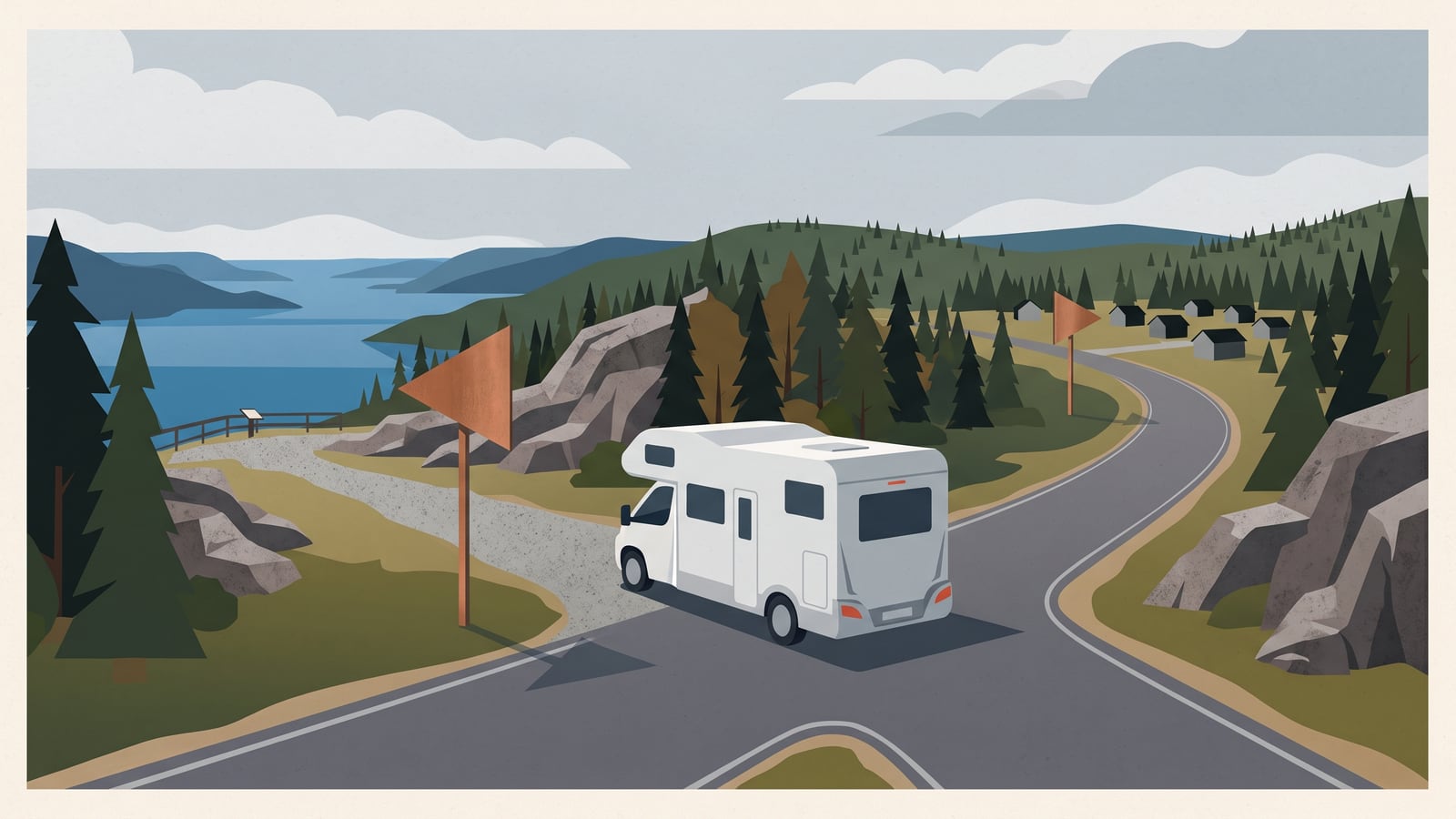
You're driving a campervan, a motorhome, or a car towing a caravan through Sweden or Norway, and you need to pull over. The question is whether the next official rest area is the right place to stop, or whether you should keep going to something built for overnight use. Here's a quick way to work that out: a three-way decision method, plain explanations of the signs that govern each stop, the country-specific rules for Sweden and Norway, and a short checklist to run before you switch off the engine.
Three types of stops and what they offer
Three kinds of places can look similar from the driver's seat but serve different purposes.
An official roadside rest area — run by Trafikverket in Sweden or Statens vegvesen and the county road authorities in Norway — exists to give drivers a safe place to pause. That's its whole job: supporting road safety through a short break, not hosting an overnight stay or a multi-day camp. You'll usually find a car park, maybe a picnic table, maybe a basic toilet — though the facilities on offer, and whether they're working that day, are worth confirming rather than assuming from a map. What you generally won't find is a green light for putting up an awning, unfolding chairs, or running a barbecue.
A dedicated motorhome stopover — a ställplats in Sweden or a bobiltomt in Norway — is built specifically for vehicles like yours to park overnight. Typical sites offer a marked parking area and, at many but not all locations, a water tap or a waste-disposal point — confirm what a specific site provides before relying on it. It's built for sleeping in the vehicle, not for spreading out a home camp.
A commercial campsite goes further again. Sites can offer full hookups — grey-water drains, chemical toilet disposal, and electricity — plus showers and laundry, and there can be room to camp properly, with awnings, chairs, and a table for dinner. Confirm what a specific site actually provides and permits with the operator, since services, check-in, and pricing vary. Of the three, it's the option most clearly set up for camping in the everyday sense.
The practical difference across all three comes down to a few things: what the site is meant for, what behaviour is allowed, what services exist for sanitation, and how long you're permitted to stay. A rest area answers a short pause. A stopover answers an overnight sleep with modest servicing. A campsite answers a proper stay with fuller amenities. Picking the wrong one either wastes money on facilities you didn't need, or leaves you without the water, waste disposal, or space you needed.
A decision framework: rest, verify, or choose another facility
Before you commit to any stop, work out which of three situations you're in.
1. You need to rest, right now. You're tired, or you just need a short pause from driving. This is exactly what a roadside rest area is for. Give the main sign and any supplementary plate underneath it a quick read. A supplementary plate is a smaller sign mounted below the main sign that adds, limits, or clarifies the rule shown above it — for example, cutting a general time allowance down to something shorter, or restricting a bay to certain vehicle types. Sweden and Norway both use this kind of plate, though the exact wording and symbols on each aren't identical, so read what's actually posted rather than assuming it matches a rule you've seen elsewhere. Check for a closure notice or barrier, and take in the site's current condition — then park fully within a marked bay and take your break.
2. You're considering staying longer, possibly overnight. Now you need to slow down and look properly. Read the main sign, then check for a supplementary plate mounted underneath it, since that's what would shorten the time you're allowed or restrict which vehicles can use the bay.
Combine that with checking whether your vehicle — and any trailer or caravan — fits entirely inside a marked bay, and whether the site has any sanitation facilities you might need. Treat a longer stay as workable here only when you can affirmatively confirm three things: your combination genuinely fits inside a marked bay, the sign and any plate don't shorten your window below what you need, and the site currently permits sleeping in your vehicle for that duration — checking the plate, a posted notice, or the responsible authority as needed. If you can't confirm one of those, treat that gap itself as the reason to move to the third option rather than assume it'll be fine.
There's one more case worth planning for here: a posted duration limit that's about to expire while you're still not fit to drive. Don't drive on unfit to beat that clock, and don't assume tiredness lets you stay past the limit either. Contact the responsible road authority or the site operator if you can reach one, look for lawful assistance or a fit relief driver, and move on only once you're genuinely fit and that move is confirmed as permitted.
3. You want a proper camp, or need servicing you won't find at a rest area. Planning to put out chairs and an awning, cook outdoors, stay more than a night, or empty grey water and recharge? A rest area isn't built for that — head for a stopover or campsite instead.
This framework is a starting point for your own judgement. It doesn't replace reading the actual signs at the actual site, and it doesn't relieve you of deciding whether a stop is safe and lawful on the day.
Three common touring scenarios in practice
These are hypothetical situations meant to show how the framework plays out. They aren't reports from a specific site, and they aren't a recommendation to use any particular rest area.
A midday driving pause. Imagine you're several hours into a long transit day and your concentration is fading. You're in category one, a short rest. Pull into the next official rest area, glance at the sign to confirm nothing rules out a stop, and park fully within a marked bay. Take a break — a walk, a meal, maybe a nap in the vehicle — and before you continue, check honestly whether you feel rested and alert. If you do, get back on the road. If you don't, extend the break rather than sticking to a fixed schedule.
An evening arrival with an overnight in mind. Say you roll in at seven or eight in the evening, tired enough that you'd rather stop than push on, and you're weighing whether to sleep there. This is category two. Check the main sign and any supplementary plate for a duration limit, confirm your vehicle — and trailer, if you're towing — fits fully inside a marked bay, and note whether there's any local restriction on overnight parking. Now imagine the plate limits the stay to a few hours, well short of a full night's rest, and you're too tired to safely continue once that limit approaches. Don't drive on unfit to beat that clock — but being tired doesn't by itself give you permission to stay past the limit either; that question stays open until someone with authority answers it. From there, the sequence of actions looks like this:
- Contact the responsible road authority. Say they can't grant a remote exception at this site, but point you toward a dedicated stopover to head for once you're fit to drive.
- You're still not fit to drive there yourself right now, so your travelling companion, who is fit to drive, takes the wheel while you rest.
- Before you commit to that stopover, your companion calls ahead to confirm it currently has space for your vehicle and is taking arrivals tonight.
- Only once that's confirmed do you continue there, where you register on arrival.
If no one else in the vehicle could drive, the next step would be to stay put, keep trying the authority or a roadside-assistance line, and wait until you're genuinely fit to move — not to treat the deadline as licence to drive unfit, and not to assume the limit has quietly stopped applying.
A full waste tank. Picture arriving with a full grey-water tank and a chemical toilet cassette that needs emptying, at a Swedish state-road rest area with only a latrine point for cassettes. There's nowhere here for the grey water, and the latrine won't take it. In Norway, the same rest area might have no disposal point at all. Either way, this is category three: the servicing need itself tells you a rest area isn't the answer, and the right move is to route to a dedicated stopover or campsite with an approved disposal station.
Swedish rest areas and road rules
Trafikverket's roadside rest areas sit on the state road network and serve the same short, safety-oriented purpose described earlier. Sweden's general parking rules allow parking on public roads for up to twenty-four hours on ordinary weekdays, with different treatment on Saturdays and days before public holidays, and on Sundays and public holidays — unless a supplementary plate or a local municipal rule says otherwise. That baseline governs parking; it doesn't by itself give you permission to sleep in the vehicle or camp at a given site — that still depends on the sign, any local provision, and the judgement covered in the decision framework above. Look for the white "P" on blue background that marks a parking area, then check underneath it for a tilläggstavla — the Swedish term for the supplementary plate described earlier — which might shorten that baseline, restrict the bay to certain vehicles, or add another condition.
Wherever you park, your vehicle needs to sit entirely within a marked bay. A motorhome or caravan combination that overhangs into a driving lane or a neighbouring bay isn't just inconsiderate — it breaks the site's parking rules.
Where a Trafikverket rest area has a disposal point, it's for emptying a chemical toilet cassette, and grey-water discharge there is prohibited. If your tanks need emptying and the site only offers a latrine, look for an approved disposal point elsewhere, typically at a stopover or campsite.
It's worth being clear about what Sweden's allemansrätt — the public right of access to nature — covers, because it's easy to assume it stretches further than it does. Allemansrätt protects unmotorised access across land and water; it does not grant motor vehicles any right to park off-road, drive across open ground, or camp by the roadside beyond what traffic signs and local regulations already allow. For the fuller legal picture of how these access rights interact with vehicles, see Nordic rights of access and what they mean for campervans and motorhomes.
Norwegian rest areas and road rules
Statens vegvesen manages rest areas along national and European roads in Norway, serving the same short-break purpose as their Swedish counterparts. Rest areas on county roads fall under regional authorities instead, and some sites close seasonally. There's no single nationwide overnight duration that applies to every Norwegian rest area. What governs a given site is the specific sign and any underskilt — the Norwegian term for the supplementary plate concept already explained — attached to it, together with any local provision and, where you need certainty, the responsible authority. Norwegian signage typically applies from where it's posted until the next junction or a sign that specifically cancels it, and an arrow plate can extend or limit that reach in a particular direction.
One rule worth keeping in mind: a passing place on a single-track road, marked with an "M," is for passing traffic only — you can't stop or park there.
For waste disposal, Statens vegvesen guidance directs motorhome and caravan travellers to empty toilet waste and other waste only at a currently operating approved disposal point — whether that's at the rest area itself or elsewhere. Not every rest area has one, so if your tanks are full, check for a nearby approved station rather than assume the rest area will handle it.
As in Sweden, Norway's allemannsrett covers something narrower than it's sometimes assumed to cover. Allemannsrett is about unmotorised access to nature; it does not grant motor vehicles any right to drive off-road, park outside the rules, or set up vehicle camping wherever you like — the actual traffic signs and local regulations still decide what's permitted. The dedicated guide on Nordic rights of access and what they mean for vehicles has the fuller legal background if you want it.
What to check before you switch off the engine
However confident the sign looks, don't take it at face value. A published map listing doesn't tell you the bay's real dimensions, whether it's currently snow-cleared, or whether the toilet's working today — treat it as a starting point, not a confirmation. The checklist below covers the specific things worth verifying.
If a posted time limit is about to run out and you're still not fit to drive safely, don't drive anyway — fatigue doesn't grant an automatic exemption to overstay indefinitely, but it also doesn't obligate you to get back on the road unsafely. Contact the responsible authority or the site operator if one is reachable, arrange lawful assistance or a relief driver if that's an option for your trip, and move on only once you're genuinely fit to drive.
If none of that's available, treat getting fit to drive as the priority. Use whatever contact the authority or operator provides to work out what's reasonable in that situation — don't assume you must move immediately, and don't assume you can stay indefinitely either.
Pre-stop verification checklist
Run through this before you settle in anywhere, whether you're stopping for ten minutes or considering the night.
- Purpose and duration check. Know what you intend to do here — a short pause, an overnight rest, or servicing — and how long that needs.
- Sign check. Read the main sign and look for a supplementary plate underneath it that might shorten, restrict, or otherwise modify what the main sign allows.
- Fit check. Confirm your vehicle — plus any trailer or caravan — sits entirely within a marked bay, with no overhang into a driving lane, a neighbouring bay, or a passing place.
- Permission check. If you're considering more than a short pause, confirm — from the sign, any local provision, or the responsible authority — that the stay and use you intend are allowed, rather than assuming it from the absence of a visible objection.
- Conditions check. Note current weather, road state, and anything else that could affect whether the site is safely usable right now.
- Sanitation check. Confirm what the site actually offers. A cassette latrine point takes chemical toilet waste, not grey water; if your tanks need emptying and there's no approved disposal point on site, plan to route to one instead.
- Fatigue check. Be honest about whether you're fit to drive. If a posted limit is about to expire and you're not, contact the responsible authority or operator and arrange lawful assistance rather than driving unfit or assuming an open-ended stay.
- Backup check. Know your next option if this site turns out to be full, closed, or the wrong fit once you're there. If the wait for fitness could run long, call ahead to confirm whether that backup site can accommodate a late or uncertain arrival before you count on it.
Working through this list turns a guess about a rest area into a checked decision, whatever the three categories above pointed you toward.
Where to go next
This guide sits in the camping and overnighting topic, alongside deeper coverage of the questions it only touched on here. If you want the fuller legal picture behind allemansrätt and allemannsrett, the Nordic rights of access guide is the natural next stop. For the broader distinction this article assumes, parking versus camping: why the distinction matters unpacks it further, while campsites, aires, Stellplätze and stopovers explained and serviced campsite or simple stopover: how to choose go deeper into the dedicated-facility side of the choice. From there, the wider road touring section covers the rest of the planning chain that surrounds a stop like this.
Your next step: open the official Trafikverket rest-area map if you're routing through Sweden, or the Statens vegvesen rest-area information if you're in Norway, and identify which authority manages the stops along your planned route.