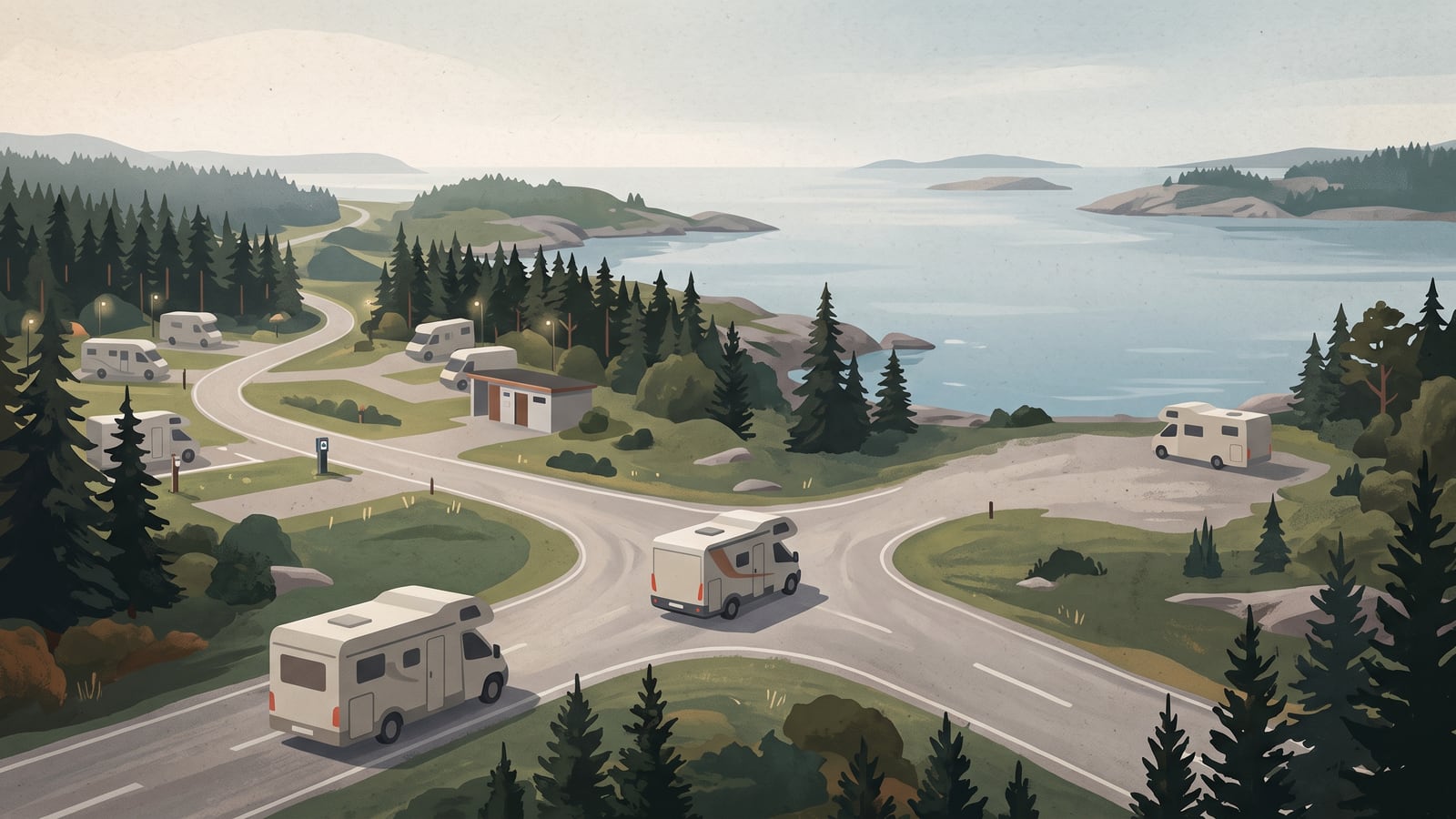
Pick whichever option solves tonight's biggest problem. If your evening turns on a proper shower, a play space, or firm ground for a wheelchair transfer, a serviced campsite is probably the stronger starting point. If you're self-contained and just want an easy, low-fuss arrival, a simple stopover might do the job better.
"Serviced campsite" and "simple stopover" are editorial shorthand here, not fixed categories. The exact place and current conditions govern what you'll actually get — permission, terms, whether your vehicle fits, which facilities exist, and whether access works for you.
Choose tonight's need
Start by naming the one thing that would make or break the evening: a hot shower, a firm level pitch, step-free access to a toilet, or simply somewhere your vehicle is allowed to stop without drama. That single need usually points to an answer faster than weighing every feature.
| Tonight's question | Serviced campsite | Simple stopover |
|---|---|---|
| Facilities and onboard independence | May offer confirmed shared toilets, showers or laundry that cut what your vehicle has to do | Works best when your vehicle already covers water, waste and washing itself |
| Arrival, routine and privacy | Booking, arrival or setup may add work depending on the site, and confirmed facilities may suit the party's routine | Can mean a quicker, simpler arrival if the place genuinely permits the stay |
| Vehicle, bay and ground fit | A pitch may suit your dimensions and offer firmer ground — confirm before you rely on it | Compare the bay or pitch dimensions against your vehicle before you commit |
| Accessibility requirements | Some sites can describe pitch and toilet access in detail if you ask | Ask the exact operator about your specific requirement before assuming it will work |
| Weather, fatigue, cost and fallback | Compare the current total cost and what's included against a stopover for the same night; neither format is inherently cheaper | Same comparison applies — check the price and services for the real options, not a general rule |
In the UK, the Highway Code says not to begin a journey when you're tired, and to stop safely as soon as you feel sleepy — reaching your preferred overnight format matters less than stopping safely when fatigue sets in.
How each option helps
Neither format wins by default; the right call depends on what you're carrying, who's travelling, and what tonight demands.
When a campsite fits
A campsite can be the better choice when your evening leans on things you don't want to run onboard: a real shower, laundry, a play area, or somewhere set up for overnight stays with a routine that suits you. Classified French camping grounds, for example, can include pitches or equipped accommodation with shared facilities, and their classification criteria cover comfort and service quality — a useful illustration of how developed a campsite system can be in one country. The French classification does not guarantee what an individual classified site offers on the night you arrive.
Booking, arrival or setup may add work depending on the site's process and your routine. If the facility you need can't be confirmed, a campsite stops being the obvious choice, however appealing the idea sounded.
When a stopover fits
A simple, parking-oriented stopover can suit a self-contained party who mainly wants an uncomplicated arrival — as long as the exact place confirms it permits the intended overnight use for your vehicle. Cornwall Council's car parks are a useful bounded example: some permit overnight parking for self-contained motorhomes while others don't, and the council points drivers to each car park's own page rather than a blanket rule. It also asks drivers to check weight restrictions and whether the vehicle suits the space, since many of these bays are standard car-parking bays rather than motorhome-specific ones. Current signs and conditions decide the answer, not whether motorhomes have parked there before.
Don't assume shared facilities exist, and remember that parking permission is a different thing from permission to camp — pitching furniture or awnings, for instance, may not be covered by the same permission that allows overnight parking. If your vehicle doesn't meet the current terms, or the bay clearly isn't suited to it, a stopover stops being the easy option it promised to be.
Three evenings, three choices
These are hypothetical situations, meant to show how the same decision plays out differently depending on what the evening requires.
A self-contained arrival
Picture two travellers reaching an area before dark in a self-contained motorhome, mostly wanting a low-effort night. A stopover could cut their arrival work, once they've confirmed the place permits overnight parking for their vehicle and the bay fits. A campsite could offer useful shared facilities, but they'd still need to confirm it's open and accepts their vehicle. With no specific facility required that night, the stronger provisional choice is whichever option they can confirm quickly and with the least arrival friction.
A family evening
Now picture a family who needs toilets, washing, food, some privacy and rest. They also need a manageable start the next morning, with the weather turning unsettled. A campsite becomes the stronger provisional choice if the site can confirm facilities that would ease that evening — a warm shower block, somewhere to wash up, some shelter from the wind. A stopover stays plausible if the vehicle already covers those needs onboard and the place confirms it allows the stay. If neither can be confirmed, the gap doesn't just affect tonight — it stays unresolved for tomorrow morning too.
Access must work in practice
Accessibility depends on the individual traveller's requirement and on confirmed details at the exact place. Asking good questions doesn't guarantee a place will work for you — it just gives you something concrete to weigh against your requirement.
Imagine a traveller who needs firm, level ground and enough clear space on the transfer side of the vehicle, with toilet access mattering just as much. Bassetlaw District Council's touring-site licence conditions, for instance, require consideration of disabled people's needs in the circumstances they cover, and address suitable hardstanding where the ground isn't otherwise safe and firm in poor weather. That's one local authority's conditions, not evidence about any other place.
Ask the exact operator:
- the bay or pitch dimensions and transfer-side clearance
- the surface and gradient, and whether there's a step-free route
- the toilet's access features, matched against your requirement
- the distance from the pitch or bay to that toilet
If the answer doesn't resolve your requirement, bring in your relevant accessibility adviser or other qualified support rather than guessing. What tips the provisional choice one way is confirmed provision for that one non-negotiable requirement — suitable hardstanding and enough transfer space, for instance — not which category the place calls itself.
Confirm before committing
Once you have a provisional choice, run through this before committing for the night.
- Permission and terms. Parking, sleeping in a vehicle, and camping are distinct uses. Confirm your intended use tonight with the exact campsite or parking operator, land manager, or governing authority, and follow current signs and terms.
- Vehicle fit. Check your loaded vehicle's dimensions, mass and class against the bay or pitch you're considering.
- Facilities and access. Confirm the services you need exist, and that any non-negotiable access requirement is genuinely confirmed.
- Arrival conditions. Check the ground, weather and signage on site. In the UK, remember: don't begin a journey when tired, and stop safely when sleepy — reaching this place isn't worth pushing through fatigue.
- A lawful backup. Have a second, confirmed option in mind before you set off for the first.
If permission, vehicle fit, a non-negotiable access need, or safe continuation can't be confirmed, use the lawful backup or change the plan.
Where to go next
Continue in camping and overnighting, where you can read how campsites, aires, Stellplätze and stopovers differ and why parking and camping are distinct uses. For the arrival-to-departure routine at an overnight stop, see sleep, privacy and manners at overnight stops, or head back to the wider road-touring section for help planning a trip end to end.
Your next step: send the compact confirmation questions to the exact place you're considering, starting with tonight's one non-negotiable need.