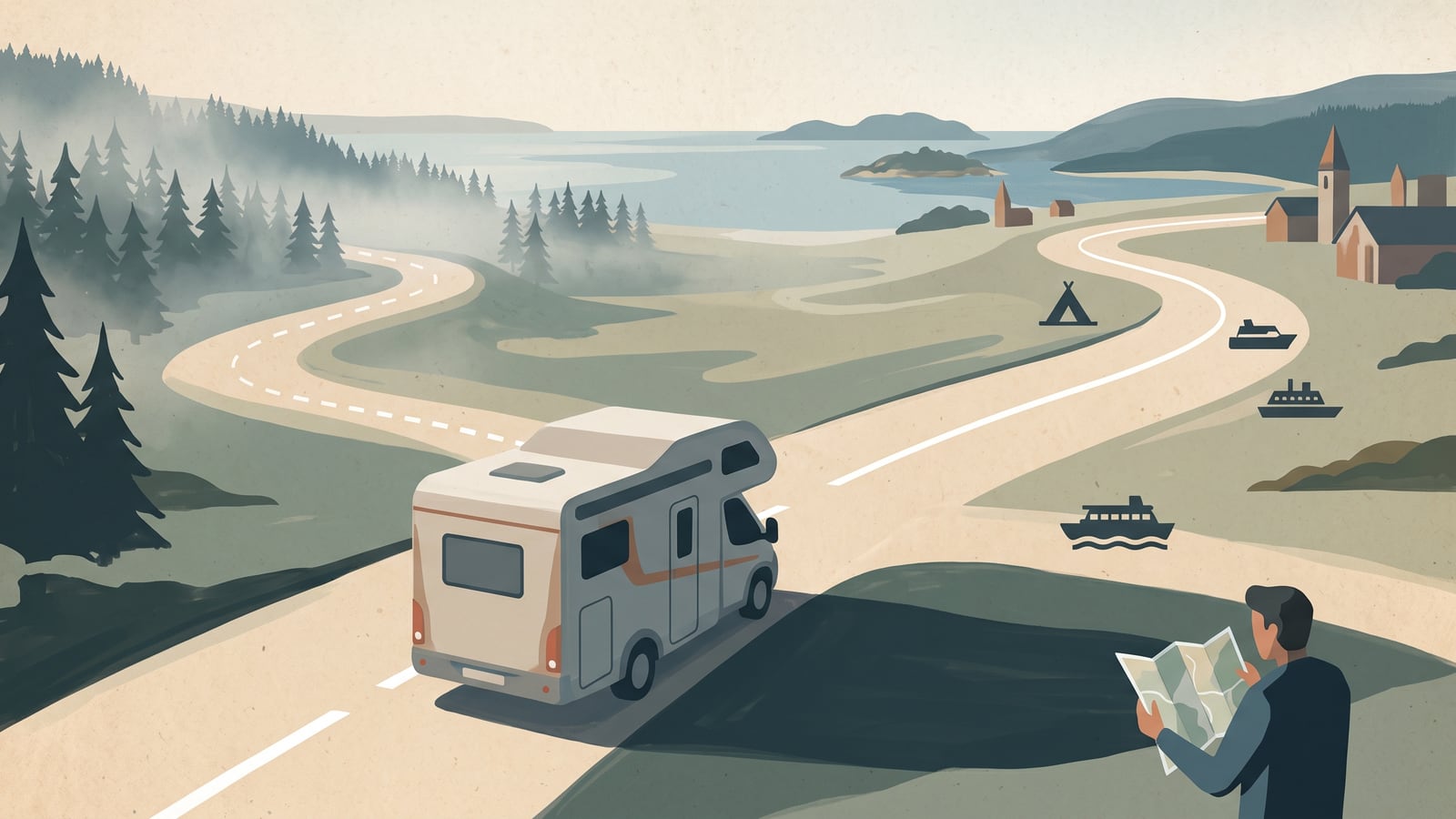
You don't need to solve the whole journey at once. Keep things adaptable unless you genuinely need advance certainty somewhere — then lock in that handful of commitments and leave room to move around them.
That gives you two broad styles of planning. An adaptable framework leaves most decisions open until you're on the road. An anchor-booking plan fixes a few stays, services, or connections in advance, while leaving the stretches between them loose. Most workable plans borrow from both.
Either way, a plan only coordinates decisions. It can't prove a route is legal, open, or right for your vehicle. It can't prove a stop will be available, or that it's safe to keep driving today.
The useful order to think in: who's travelling and what vehicle you're using, then route and timing, then stops and services, then rules and paperwork, then what you'll do if something goes wrong.
Choose what to fix
Start by deciding which uncertainties you need to remove before you leave. Leave the rest open if you can handle them as you go.
| Decision | Adaptable framework | Anchor-booking plan |
|---|---|---|
| Commitment and flexibility | More freedom to shorten a day, wait, or reroute | More certainty around the things you've locked in |
| Day-to-day workload | More live checks and decisions | Fewer open decisions, but firm arrival commitments |
| Traveller needs | Works when confirmed alternatives can cover them | Works when a routine or arrangement needs certainty |
| Rental and unfamiliar vehicles | Leaves room to get familiar with the vehicle early on | Can lock in an important first stop, but adds time pressure |
| Cost | Leaves some stay and contingency costs open | Commits some spending earlier and may make changes costly or consequential |
Neither column is a full plan by itself. Flexibility only works if you have legal, suitable alternatives. An anchor only works if you leave room for delay, changed conditions, or a missed arrival.
Your vehicle situation shapes this too. A vehicle you own and know well removes questions about collection and getting familiar with it, though it's its own financial commitment. A hired vehicle brings a booking, a contract, and a specific vehicle you need to understand before you build a route around it.
Budget matters, but there's no single cheapest way to do this. Consider the costs your plan creates. These include owning or hiring the vehicle, travel, stays, food, and services. Leave room for the costs a change might create, like switching stops or altering a booked leg of the trip.
An adaptable framework
Start here if you like changing your day as conditions or energy shift, and you can keep more than one workable stopping option open.
This makes a shorter day, a wait, or a reroute a normal decision rather than a crisis. It also stops one delay from wrecking a chain of later bookings.
The cost is effort. You need current information and alternatives that are legal, suitable for your vehicle, and workable for everyone travelling with you. Some questions about availability and price may stay open until you get there, and that uncertainty can wear thin late in the day.
This approach makes less sense if you need a specific accessible setup, private space, service, or time-sensitive connection — or if your plan quietly depends on one unconfirmed stop. An unconfirmed stop isn't permission, space, suitability, or affordability. It's just unconfirmed.
An anchor-booking plan
Start here if a few stays, services, routines, or connections determine whether the trip works. An anchor is something you lock in ahead of time because missing it would genuinely hurt the trip.
This cuts uncertainty and the number of decisions you'll face on the road. But every anchor also creates a place or time you may feel pressured to reach — which means it needs a fallback for delay, a change of plans, or a missed arrival.
This gets fragile fast when several commitments sit back to back with no room to stop, wait, or cut a day short. A booking doesn't tell you the road is open, that your vehicle fits, or that pushing on to meet it is a good idea.
Start with people and vehicle
Before you draw a route, work out what determines your group's usable day. Rest, privacy, food, and toilets matter. So do weather exposure, luggage, how much living space you need day to day, and any routine you can't skip.
Those needs shape which commitments are worth locking in ahead of time. A group that needs something specific probably wants a few anchors. A group whose needs can be covered by several confirmed alternatives can leave more of the route open.
Accessibility needs can decide whether a stop works at all — but you need to confirm the actual arrangements directly with the provider, current and specific to your situation.
Then figure out the vehicle you're using. "Campervan" and "motorhome" are useful shorthand, but neither tells you dimensions, mass, layout, or how it'll fit the route. Those come from the real vehicle in front of you. Its living space has to work for your travellers and luggage — a category name can't settle that.
Familiarity matters too. A vehicle you own and know well is a different planning problem from a rental or anything unfamiliar. With the latter, collecting it, getting familiar with it, and loading it all compete with your first day of actual driving.
When flexibility takes the pressure off
Picture a solo traveller in a familiar vehicle with nothing urgent waiting at the next stop. They can leave most stops undecided, as long as they keep legal alternatives in hand and do the live checks that day requires.
If their concentration drops, a confirmed shorter-day option lets that day shrink without wrecking several later bookings. One anchor might still be worth having if certainty solves a real problem — but that booking still needs a fallback in case arrival gets delayed.
This isn't an argument that solo trips should never be booked. Flexibility helps when it removes pressure, and when the traveller has the options to back it up.
When certainty makes the day work
Now picture a family whose day depends on predictable privacy, toilets, food, and rest. A few anchors probably make more sense here, because those arrangements decide whether the next leg is even workable.
Any required arrangement still needs direct confirmation for this family's actual needs — that confirms what the provider has agreed to, not whether the wider route makes sense.
A fully open plan would preserve more routing freedom, but it would also pile up more decisions and demand solid backups. Here, the group's usable day should drive the plan. Distance covered isn't the point.
When the vehicle itself is unfamiliar
Picture a first-time renter picking up an unfamiliar vehicle and crossing into another EU country early in the trip. Stack unfamiliar controls, a border crossing, and a time-critical arrival into one day, and you've got three unresolved problems competing at once.
A simpler first day leaves room to learn the vehicle and gives you a shorter-day fallback. An anchor could still secure an important first stop — but sort out the rental and the border question first.
EU guidance on hiring a car says you should flag any planned cross-border travel when you book. Confirm with the actual provider that it's permitted, and check the documents, insurance, and breakdown cover you'll need, along with what your licence allows you to drive.
That guidance is about car hire — it says nothing about any specific campervan company's terms. Your actual contract and the vehicle you're assigned are what govern the rental.
Build touring days, not map hours
A route planner gives you driving time. A touring day also holds stops, food, services, delays, and the work of arriving somewhere. Map hours can't tell you a safe distance, a safe driving stretch, how often to rest, or how much reserve to keep.
Say your energy dips partway through an ordinary day. With an adaptable framework, you switch to a currently confirmed shorter-day option. With an anchor-led plan, you might need an agreed late-arrival arrangement, another legal stop — or you might simply miss the booking.
The itinerary never overrides how the driver feels. Fatigue is a safety issue, and no single driving or rest limit fits every private tourer. If the driver is sleepy, impaired, unwell, or uncertain of readiness, stop when it's safe. Wait or reroute.
Give every commitment a fallback
Each important day or anchor needs one real alternative. Depending on the trip, that might be:
- another stop you've confirmed is currently available;
- a shorter day;
- a late-arrival arrangement you've confirmed with the provider; or
- a decision to wait or reroute.
An alternative only counts if you can confirm its permission, suitability, and key terms for your actual trip. That's what turns flexibility into something you can act on, rather than a hope that something will turn up.
Missing a booking or changing the route might be a hassle. It has to stay possible.
Make the final checks
Once the broad plan holds together, run through one compact check before you go:
- Countries: Check every country you'll visit or pass through with the relevant current authority. Speed limits and alcohol rules differ across the EU, and so do equipment, lighting, winter tyre, and driving-side rules. EU guidance won't tell you any single country's specific requirements, and it doesn't cover non-EU Europe at all.
- Vehicle: Confirm the paperwork and the licence category you need to drive it. Check its actual dimensions and mass against any route restrictions, and follow its own instructions. Treat warning lights, damage, leaks, alarms, or unfamiliar operation as vehicle-specific uncertainty. Check the vehicle instructions or contact the rental provider, roadside assistance, or a qualified mechanic.
- Rental contract: If you're hiring, confirm which countries and driver conditions the actual provider allows before you book — then check the documents, insurance, and assistance cover separately.
- Stops and operators: Confirm any permission, access, or arrival arrangement your plan depends on. Check essential services or accessibility directly with the operator.
- Live conditions: Recheck roads, weather, and closures whenever they could affect your next leg. Reassess your stopping options and how you're feeling as the day goes on.
If you can't confirm a required permission, document, or contract term, change the plan. Same goes if you're unsure whether the vehicle fits, a road is open, or you have a safe place to stop.
Your next step is small: write a short trip brief. Name who's travelling, the vehicle you're considering, every country you'll visit or pass through, your first few days, and one fallback for each commitment that might otherwise force you onward.
Where to go next
This sits in Getting started, alongside choosing between a campervan, motorhome, caravan or car and the mistakes that make a first tour brittle. When the idea turns into dates and stages, see how to plan a realistic multi-day tour and what to book and what to leave flexible. The wider Road touring section covers planning, routes, rules and overnighting.