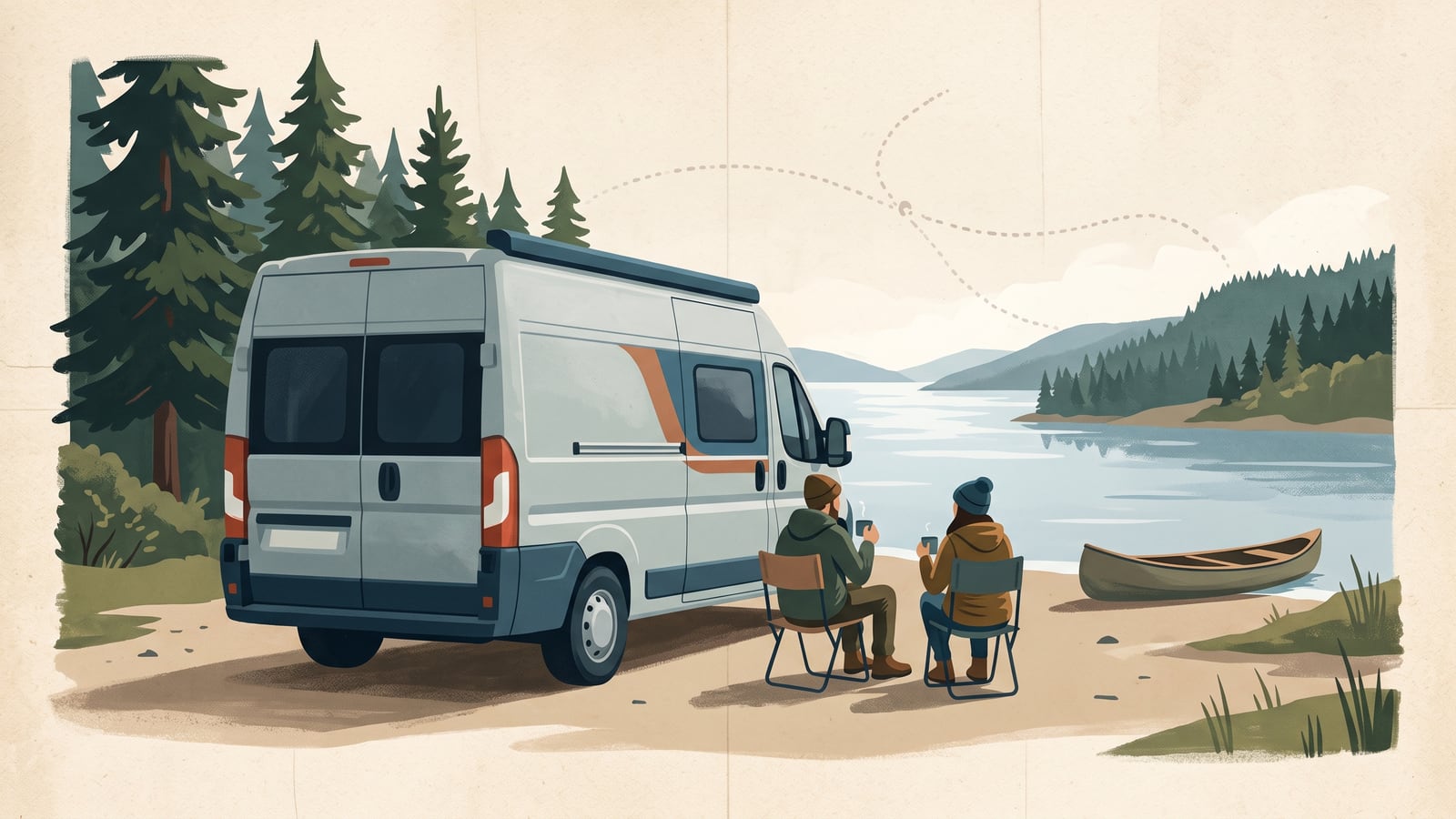
A good first campervan or motorhome weekend has one real job: get you and the vehicle used to each other before you worry about distance. Give the plan room to breathe — spare time to work out the bed, spare time if the road takes longer than you expected, and a backup if the place you meant to stay doesn't pan out.
This is a planning method for one local overnight, written especially for renters and anyone driving an unfamiliar vehicle for the first time. It won't tell you your route is sound, that a place is lawful to stay at, that the vehicle is in good order, or that any particular call you make on the day is the right one. Those checks are still yours to make, with its documents, the relevant authorities, and your own judgement in the moment. What this method gives you is a place to start.
Keep the weekend small
Before anything else, open a note — on your phone, a notebook, whatever's at hand — and start filling in six lines. You'll add to it as you read, but starting now gives you somewhere to put every loose thread instead of carrying it all in your head.
Start one short note
Copy this:
Intended overnight:
Lawful backup:
Questions about this vehicle:
Surprises or items to check:
Roadside-assistance contact and confirmed scope:
Official, operator, provider, or document checks still required:
Fill in whatever you already know and leave the rest blank. If you have roadside-assistance contact details, write them down, along with a line to confirm the actual scope of that arrangement rather than assuming it. This note is a personal planning aid. It isn't a route record, a legal permission, a safety certificate, or proof it's roadworthy — it's just a place to keep track of what you still need to check.
If you're helping someone else get ready for their first trip, you can work through this note and the vehicle questions together. The driver still carries responsibility for operating the vehicle and for any live decision on the road.
Use a small-weekend pattern
With the note started, you can shape the weekend itself. Here's an optional starter pattern, not a formula:
- Pick a destination close enough that getting there isn't the whole trip.
- Confirm the overnight is currently available and lawful before you rely on it.
- Identify a lawful backup in case the first option falls through.
- Leave room to shorten, reroute, wait, or abandon the plan if something doesn't fit.
No distance suits everyone, so this deliberately avoids naming one. What matters is that the plan allows for breaks and possible delays, for the time it takes to get used to an unfamiliar vehicle, and for whatever arrival tasks — parking, levelling, finding the right spot — turn out to take longer than you guessed. A weekend with no slack in it turns ordinary friction into a bad afternoon.
Get to know this vehicle
Plan for the unfamiliar vehicle as carefully as you plan the destination. A campervan or motorhome is also a small set of systems you've probably never operated. Start with the actual manual, handover material, owner documents, or rental contract for the exact vehicle you have — a friend's van might work completely differently, and intuition isn't a reliable guide here.
Work through these as illustrative questions, not instructions, because equipment and procedures vary between vehicles:
- Where are the driving controls, and how do you use them?
- What dimensions and mass does the paperwork state, and do any of them affect the road, entrance, pitch, or parking space you're planning to use?
- What has to be secured before you drive?
- How do the doors and locks work?
- What do the documents say about isolating power or gas?
- What do you need to know about water, waste, and any electrical hookup?
- How is the bed set up, and how do you get it back to a safe driving configuration?
- What alarms are fitted, and what do their instructions require?
- Who provides roadside assistance, how do you reach them, and what does the arrangement cover?
Write every unanswered question straight into your short note. A first overnight is a reasonable place to discover you don't know how the water pump works. It's a much worse place to discover it for the first time thirty minutes after everyone's asleep.
Confirm the stay and route
Once those questions are underway, turn to the stay itself. This is where the detailed checks belong, gathered in one place rather than scattered through the trip.
Confirm both your intended overnight and your backup with whoever actually governs them: the governing or local authority for the area, the landowner or land manager, and any operator terms that apply to the place. Read the current signs and restrictions on site rather than relying on what a map listing or a previous visit suggested — a booking, a map pin, or someone else's past stay doesn't prove the place is available or lawful for you today.
Alongside that, check the vehicle's documented dimensions and mass against the actual road, entrance, pitch, or parking space you're aiming for. And before you leave, check the current road conditions, weather, and any relevant travel advisories, the same way you would for any drive.
Know when to stop
Don't begin the drive while tired, and if sleepiness develops on the road, stop in a lawful and safe place when it's safely possible to do so. That instruction holds under the Highway Code for drivers in England, Scotland and Wales. Separately, US road-safety guidance from NHTSA warns that fatigue can impair cognition or performance and contribute to crashes, and advises a sleepy driver to pull over somewhere safe — the same direction, scoped to its own jurisdiction. Between the two, there's no universal sleep or rest threshold to lean on. The instruction is simply this: stop when it's safe, instead of trying to calculate how much longer you can push on.
Beyond fatigue, here are other normal reasons to change the plan instead of pushing through it:
- Your current alertness and conditions — tiredness, weather, visibility, road state, or a closure — don't support continuing as planned.
- Permission for the intended stay or its backup can't be confirmed.
- The vehicle doesn't fit the road, entrance, or space you were counting on.
- An alarm sounds, or you notice a defect, a leak, damage, or a control or system you can't account for.
In any of these situations, it's reasonable to reroute, wait, shorten, or abandon the stage rather than continue on the original plan. This article can't tell you what's happening right now — for live conditions, check with the road, weather, emergency, and access authorities relevant to where you are. And if the issue is the vehicle itself — an alarm, a fault, a system that behaves unexpectedly — the right next step is the exact vehicle manual, the rental provider, roadside assistance, or a qualified service, not a workaround you improvise on the spot.
Keep the useful surprises
The same short note is useful again once the trip is done. Whatever surprised you — a control you couldn't find, a question the manual didn't answer, a stay that turned out to need a permit you didn't know about — becomes useful material once it's written down instead of left to memory. None of this needs to be a formal record or a pass-or-fail test of the weekend. It's just the raw material for planning the next one with fewer open questions.
Where to go next
This article lives in Beyond Bothnia's getting-started hub, alongside guidance for readers still shaping their approach to touring rather than already executing a settled route. If you haven't picked a vehicle yet, compare touring vehicle types walks through that choice. If this is your first trip of any length, avoid common first-tour planning mistakes covers planning errors worth knowing about before you go. When you're ready to think about where to stay, choose between a serviced campsite and a simple stopover picks up where this article's stay-confirmation section leaves off. And before you set off, run a departure check extends the questions raised here. All of it sits within Beyond Bothnia's wider road touring coverage.
Your next step: open one short note and write down the intended overnight, the lawful backup, and the first unresolved question you have about the actual vehicle.